Science First, Connection Follows: The Psychology Behind Forensic Horsemanship
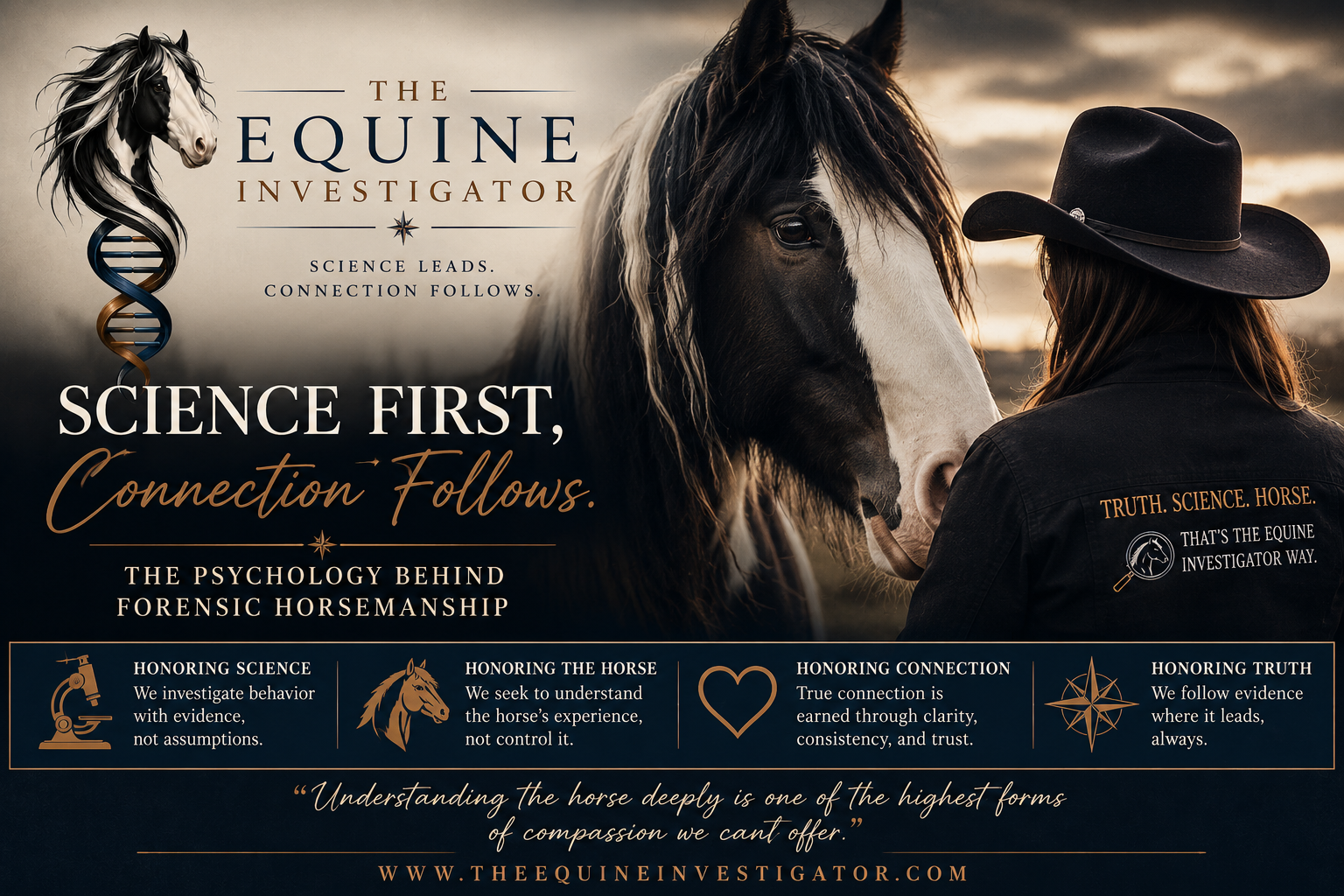
One of the biggest mistakes people make in the horse world is believing connection comes first. I think maybe attraction comes first that can lead to connection. Everybody wants the bond. I do too. Everybody wants trust, softness, partnership, and that picture perfect relationship with their horse. I have this with my Gypsy Vanner gelding, Aegon “Egg”, but very few people stop long enough to ask what the horse is actually experiencing when interacting with us. Horses are not mind readers. They don’t respond to our intentions, they respond to pressure, timing, consistency, movement, emotion, environment, and predictability for starters. Obviously, as prey animals they respond to lots of “bad” stimuli as well. But overall, horses respond to our psychology whether humans recognize it or not…this is a foundational concept of Forensic Horsemanship.
As an “Equine Investigator” who studies the horse, I approach horses the same way I approach suspicious deaths. I put evidence first. I investigate behavior instead of reacting emotionally to it just like I do in homicide. I study patterns, context, environmental changes, pressure, reinforcement, and conflict before I ever jump to conclusions about the horse itself. Too often humans label horses stubborn, disrespectful, lazy, cold, dramatic, reactive, or difficult when in reality the horse is simply responding logically to something the human has failed to recognize.
Behavior is information. Horses communicate constantly, but humans often misinterpret what they are seeing because they filter equine behavior through human emotion instead of equine psychology. A horse refusing to load may not be defiant. A horse refusing fences may not be naughty. A horse that suddenly becomes difficult to catch may not have developed a bad attitude overnight. Something changed. Something shifted psychologically, environmentally, physically, behaviorally, or emotionally. The horse is responding to that change whether we understand it or not.
That is why Forensic Horsemanship asks different questions. Instead of asking, “How do I stop this behavior?” I ask, “Why does this behavior exist in the first place?” What pressure is present? What conflict exists? What changed in the environment? What does the horse gain by the behavior? What does the horse avoid through the behavior? What reinforcement patterns are happening whether the human realizes it or not? Those questions matter because horses are incredibly logical animals. Humans are often the unpredictable variable in the equation.
Additionally, one of the most misunderstood concepts in horsemanship is the difference between suppression and connection. A shut down horse is not necessarily a calm horse. A compliant horse is not always a confident horse. Sometimes the horse simply learns resistance no longer matters. Humans often reward suppression because suppression looks obedient. But true connection cannot be forced. Connection is built when the horse begins to experience the human as fair, predictable, emotionally regulated, and behaviorally consistent. That predictability creates security and security changes everything psychologically for the horse.
The horse world today sometimes acts like science and connection are opposites when the exact opposite is true. Science strengthens connection because science helps us understand the horse more clearly. It explains why timing matters. Why pressure and release matter. Why inconsistency creates anxiety. Why emotional regulation matters. Why horses habituate to stimuli. Why environmental pressure affects learning. Why human tension affects equine behavior. The more we understand the horse scientifically, the more ethical and effective our horsemanship becomes. An existential, yet scientific approach…that’s Forensic Horsemanship. Interestingly, I was not a fan of existential, or Gestalt, psychology when I was in undergrad and grad school. It was not until my doctoral work I found some use for it. Why? Because my focus shifted. As a young undergrad I thought I wanted to rehabilitate homicide offenders in prisons. Existentialism will not work for that practice at all in my opinion. I quickly realized I did not want to rehab them, I wanted to study them and help catch dangerous humans in society. I found this to be way more challenging than my first idea and definitely more challenging than training horses. But after all these years in horsemanship since I was a kid and now 29 years in psychology, I realize training horses that are “bad” or need rehabilitated is more similar than different to hunting killers. The psychology is similar. The challenge is similar. The frustration can be similar and the list goes on. That’s how I built Crossroads Ranch’s Forensic Horsemanship system from The Murder Room system.
Forensic Horsemanship is pro-connection. Relaxation and connection for horse-human partnership is the goal. “Solving horse problems for horse people” is our motto. It honors connection enough to build it on truth instead of projection. Horses deserve to be understood as horses. Not as emotional projections for humans. Not as machines. Not as romanticized symbols disconnected from biology, behavior, psychology, and environment. The horse deserves investigation before judgment.
One of the greatest lessons I have learned through both death investigation and horse training is that emotion without method can create really erroneous conclusions. Humans naturally rush toward emotional explanations because emotional explanations feel satisfying…we saw this in the Murdaugh conviction vacatur…the outrage, the accusations of corruption and more. And it is a fact that conclusions reached without investigation are often wrong. That applies in homicide investigation and it applies in horsemanship. The horse labeled dangerous often left a long trail of overlooked indicators or at bare minimum misread indicators. The horse labeled difficult may actually be conflicted, overstimulated, fearful, or confused…suppressed, but definitely disconnected. And these horses labeled disconnected may have simply stopped trying to communicate because previous communication attempts were ignored or punished.
When humans slow down enough to truly investigate the horse, everything changes. When humans actually slow down enough to investigate a homicide, everything changes too. Amazing, truly. The horse becomes safer. The case solves. The human becomes clearer to the horse. The conflict becomes clearer to the investigator. Communication becomes more precise. Evidence speaks. Pressure becomes more intentional and the horse responds. Pressure becomes more intentional and the suspect responds. Trust becomes more authentic. Facts are authenticated. That is the foundation of Forensic Horsemanship and The Murder Room scientific death investigation. Science leads so connection can follow, not because science removes compassion from horsemanship, but because understanding the horse deeply is one of the highest forms of compassion we can offer in the first place.