When Horses Read What Humans Miss: Lost Person Behavior Through the Lens of the Equine Investigator
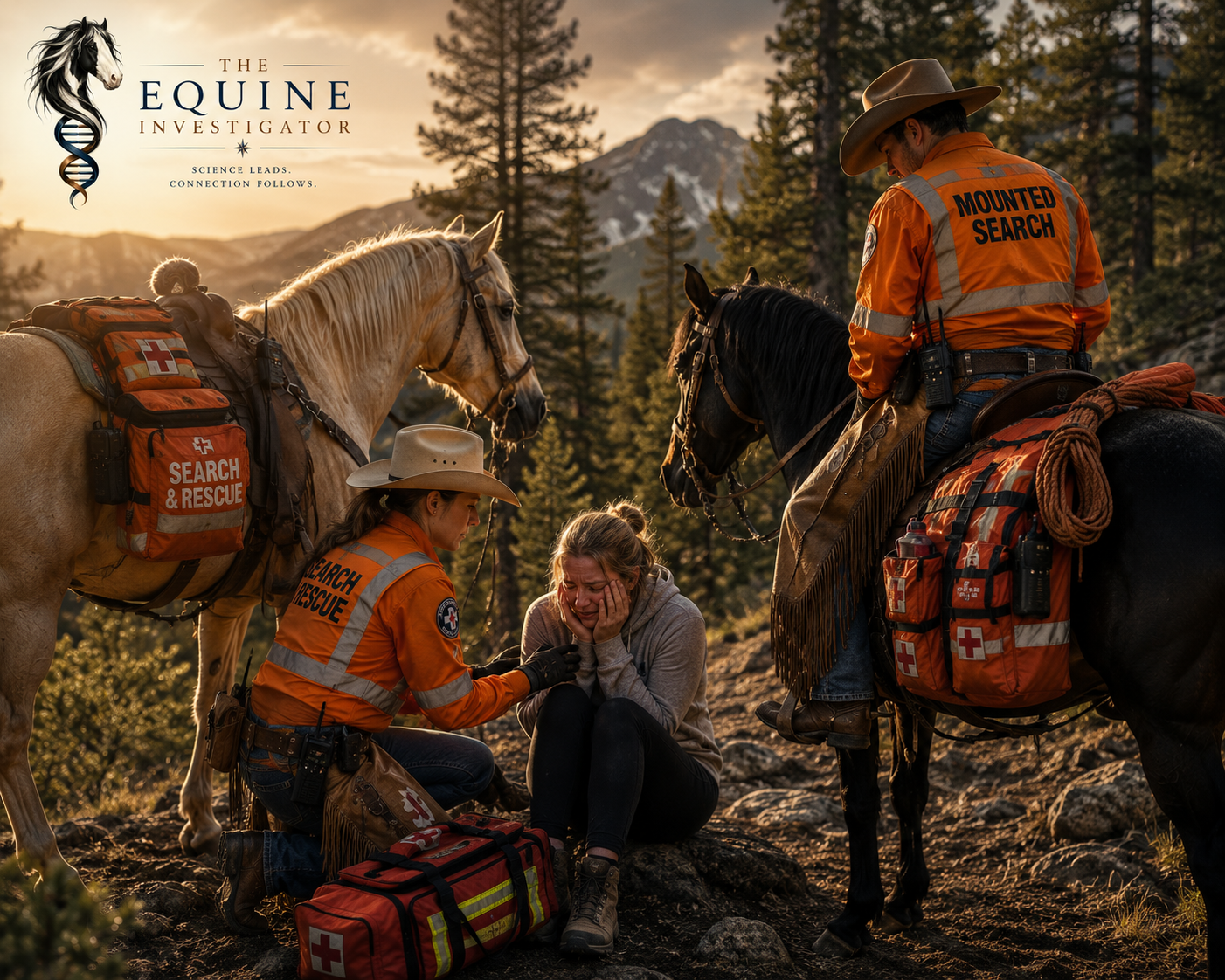
There is a reason mounted search teams continue to matter in modern search and rescue operations. Not tradition, definitely not nostalgia. It is because horses process environments differently than humans do and often detect behavioral abnormalities long before people recognize them. As an Equine Investigator, I spend a great deal of time studying behavior. Human behavior. Horse behavior. Environmental behavior. Pattern behavior. The reality is that lost person behavior is not random. People do not simply vanish into thin air. They move through environments with intention, panic, confusion, exhaustion, injury, fear, or cognitive impairment shaping their decisions. Those behavioral factors leave patterns behind. The problem is that many search efforts still focus heavily on grid coverage while underestimating behavioral interpretation. Coverage matters, but behavior tells you where to look first. This is where horses become incredibly valuable.
A horse moves through terrain while constantly scanning for environmental changes. Their survival depends on noticing what does not belong. They process scent, movement, tension, sound, spatial abnormalities, and subtle disturbances humans often overlook. Riders who truly understand their horses learn to recognize those changes in real time…that’s Forensic Horsemanship: science leads so connection can follow.
And of course I always go back to Method Matters: A horse suddenly locking onto a wooded edge matters. A hesitation crossing an otherwise normal trail matters. Repeated attention toward a drainage ditch, creek bed, ravine, or heavy brush line matters. Horses frequently recognize disrupted environments before handlers consciously process the evidence themselves. Lost person behavior frequently follows predictable psychological and physiological pathways. Children behave differently than hikers. Dementia patients behave differently than suicidal subjects. Injured individuals behave differently than fugitives. Autistic children often exhibit attraction behaviors toward water, lights, or enclosed spaces. Elderly dementia patients may continue traveling until physical exhaustion overrides mobility. Suicidal individuals may intentionally select concealment terrain or emotionally meaningful locations.
Behavior creates probability, probability shapes search strategy. The mistake is assuming search operations are purely physical exercises. They are cognitive exercises. They are behavioral exercises. They are environmental interpretation exercises. The terrain itself becomes part of the evidence. For these reasons I have spent the past year building my new Mounted Forensic Response System based on international MSAR guidelines, but coupled with forensic science and forensic psychology.
One of the most overlooked realities in lost person investigations is that humans project logic onto missing individuals that may no longer exist under stress conditions. Once fear, hypothermia, injury, fatigue, dehydration, intoxication, cognitive decline, or panic enter the equation, decision making changes dramatically. People begin making survival based, emotional, or irrational navigational choices. All of this is very operationally important for a successful outcome.
A healthy experienced hiker may backtrack intelligently. A frightened child may hide silently only feet away from searchers. A dementia patient may continue moving in a singular direction without seeking help. An injured subject may attempt to crawl toward perceived shelter or water sources. We have to use psychology for countermeasure. In my opinion as a forensic criminologist, behavioral interpretation changes deployment priorities. This is why deploying untrained persons is dangerous, is a liability to everyone, and should not happen. In all the research I’ve done over the past two years about mounted search and rescue, one thing is clear, training people is just as important as training the mounted search horse. My new system aims to fill the gap between what is currently done in mounted search and rescue with forensic science and forensic psychology.
This is why mounted units can become incredible multipliers during search operations. Horses provide mobility, elevation, endurance, environmental access, and behavioral sensitivity simultaneously. They cover terrain efficiently while also functioning as living environmental detection systems. A good mounted search rider is not simply riding through the woods. They are reading behavior. They are thinking about evidence. They are analyzing terrain transitions, environmental anomalies, movement pathways, concealment opportunities, stress indicators, interrupted vegetation, and equine behavioral responses. Mounted searchers must continuously ask:
What would a frightened person do here?
What would an exhausted person do here?
What terrain psychologically pulls or traps people?
What terrain hides people?
What terrain slows them down?
What terrain gives false confidence?
That mindset changes everything.
In homicide investigation, we use “genoenvirosocioculturalism”. This was my word for how the environment, society, and culture influence the personality traits, emotionality, thinking, and behavior of the homicide offender. Search work and forensic work share more similarities than most people realize. Both require pattern recognition. Both require objectivity. Both require resisting assumption contamination. Both require understanding that evidence exists whether humans immediately recognize it or not.
And horses? Horses are often reading the environment before we are. That does not mean horses are magical. It means they are biologically designed for environmental awareness in ways humans are not. When riders learn how to interpret those responses scientifically instead of emotionally, horses become extraordinary operational partners. This is one reason I believe the future of mounted response work must evolve beyond tradition alone. Search teams need behavioral training. They need environmental interpretation training. They need scientific frameworks that explain why people move the way they move under stress and how horses interact with those changing environments.
The horse is not replacing science. The horse is helping us apply it. That is the foundation of Forensic Horsemanship and the Mounted Forensic Response System approach. We are not just training horses to navigate obstacles. We are training humans to think differently about evidence, behavior, terrain, and connection. Because sometimes the difference between finding someone and missing them entirely comes down to recognizing what the environment and the horse have been trying to tell us all along.