Pettler’s Mounted Forensic Response System
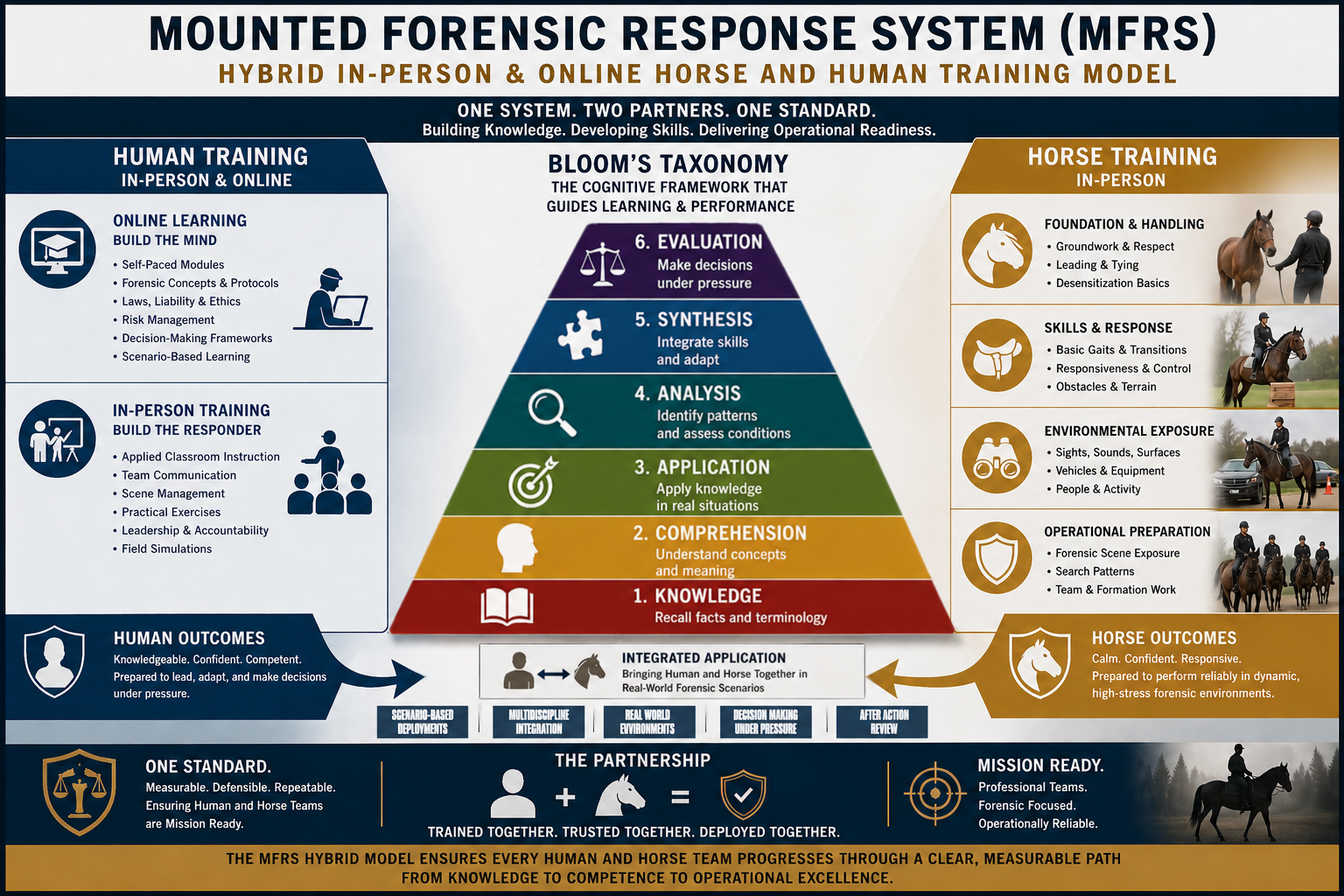
Pettler’s Mounted Forensic Response System version 1.0
A Multidisciplinary Approach to Mounted Operational Readiness
Pettler’s Mounted Forensic Response System v1.0 (MFRS) is a comprehensive framework designed to develop, implement, and operationalize civilian mounted units to assist law enforcement and emergency services for search, response, and recovery in complex and remote environments. Built from the ground up by forensic criminologist Dr. Laura Pettler, the system integrates equitation, operational discipline, and evidence-based methodology into a single, unified model for horses and humans.
Grounded in empirical research and aligned with ASTM basic standards for mounted search teams, NASAR’s Fundamentals of Search and Rescue, along with basic requirements for NASAR’s recommended equipment list, Pettler’s MFRS 1.0 establishes a level of consistency, safety, and operational integrity that exceeds informal or traditionally developed programs. The ASTM framework defines the minimum knowledge, skills, and abilities required for mounted search personnel, while placing responsibility on the authority having jurisdiction to determine training depth, evaluation methods, and operational requirements. MFRS builds directly on that foundation.
Rather than stopping at minimum standards, the system expands them into a fully structured operational model that includes unit architecture, performance benchmarks, certification pathways, and evidence-aware deployment protocols. The result is not simply a trained mounted team, but a professionally developed unit with defined expectations, measurable outcomes, and long-term scalability. Unlike traditional mounted programs that evolve informally or rely solely on horsemanship, MFRS is constructed with the same level of structure and intentionality found in professional investigative and response systems. Every component is purpose-built, every standard is defined and every outcome is measurable, a foundational characteristic observable in all of Pettler’s Methods.
At its core, the system is anchored in four foundational pillars: Safety, Equitation, Performance, and Evidence. These pillars ensure that both horse and rider are not only capable in the saddle, but also reliable under pressure, responsive in dynamic environments, and aligned with operational objectives. Instruction within Pettler’s Mounted Forensic Response System is delivered through a collaborative, multidisciplinary model that reflects the realities of field operations. Training integrates expertise from law enforcement, certified search and rescuers, professional horse trainers, crime scene investigators, forensic criminology, emergency medical services, and fire service personnel. This cross-disciplinary approach ensures that both horse and rider are developed not only in equitation and control, but also in communication, situational awareness, and coordinated response within complex operational environments.
The MFRS model begins with unit architecture. This includes the development of mission scope, operational roles, chain of command, and deployment protocols. From there, the system establishes standardized procedures that guide response behavior, communication, and scene integrity. Even in non-law enforcement environments, the structure reflects professional response standards, ensuring consistency, accountability, and credibility. Horse selection and development are approached through Pettler’s Forensic Horsemanship methodology or at the discretion of the unit’s leader, prioritizing behavioral analysis, suitability assessment, and evidence-based training progression. Horses are not simply trained. They are evaluated and developed as operational partners, capable of functioning in unpredictable terrain, high-stimulus environments, and prolonged field conditions to mitigate liability and to enhance success.
Rider development follows a parallel path. The system defines clear performance benchmarks and introduces a structured certification framework, including the Certified Mounted Search and Rescue Recovery (CSMAR) designation and additional ratings based on terrain, operational complexity, and response type. This aligns with ASTM guidance requiring demonstration and validation of knowledge, skills, and abilities through structured evaluation, while expanding those requirements into a scalable and trackable certification model. The CSMAR is an awareness-level certification only. It is earned internally after successful completion of safety, equitation, mock deployment, evidence recognition, CPR/First Aid, incident command, and related training modules are complete.
What distinguishes MFRS is its emphasis on evidence awareness and scene integrity, even in environments where traditional investigative frameworks may not be present. This layer introduces a level of professionalism that extends beyond recreation or basic search functions and positions the unit as a credible operational resource. Implementation of the system is hands-on and tailored to the specific environment in which the unit will operate. Terrain, climate, use case, and organizational goals are all factored into the design. The result is not a generic program, but a fully developed unit with defined standards, operational readiness, and long-term scalability. Pettler’s Mounted Forensic Response System is an applicable model for civilian unit development. It is a field-structured, standards-aligned operational model designed to produce civilian mounted units that perform with clarity, consistency, and purpose.
Testing and Validation
Pettler’s Mounted Forensic Response System version 1.0 was developed and implemented in 2025 by Dr. Laura Pettler in collaboration with Coroner Karla Deese and leadership of the Lancaster County Coroner’s Office Mounted Response Unit, the first mounted unit established within a coroner’s office in the United States. The system was built, deployed, and tested in an operational environment. Training launched in April 2025 and by November 2025, six horse and rider teams successfully completed the internal LCCO MRU Certified Mounted Search and Rescue (CMSAR) program, demonstrating the system’s ability to produce measurable, validated outcomes within a defined training period. The unit moved on to a mock cold call out scenario in April 2026, then deployed on a search for a missing elderly man in May 2026.
The 2025 CMSAR training program incorporated structured aptitude testing across both equine and rider performance domains. Evaluation presented by MRU leadership components included:
Trailer safety and loading under controlled conditions
Ten foundational riding techniques required for operational control (walk, trot, canter, halt/back up; right and left: turns on the haunches, forehand, and side passes.) (We call this the Basic 10)
Search pattern formations and coordinated team movement
Timed obstacle courses designed to assess performance under pressure
First aid knowledge and response readiness
Crime scene investigation fundamentals and evidence preservation protocols
Autopsy and necropsy training
Mock searches and completion of integrated online coursework (equipment, search/rescue/recovery, NASAR, ASTM basic guidelines for mounted units, the LCCO MRU SOP, and more)
Consistent with NASAR and ASTM guidance, validation of knowledge, skills, and abilities was conducted through a combination of demonstration, scenario-based evaluation, and performance testing. Both horse and rider were assessed individually and as a team within controlled environments prior to final qualification. This testing structure ensured that certification was not based on participation, but on demonstrated competency. The successful completion of the CMSAR final examination by all six teams confirmed that the system is capable of producing basic operationally ready mounted units with standardized training, measurable performance, and repeatable outcomes.
For more information about building your new Mounted Response Unit, contact Laura Pettler & Associates, or Instructors Laura Pettler, Chris Herman, or Grant Durham.