Brenden Banfield Found Guilty
A Case Study in Staging and Bloodstain Evidence
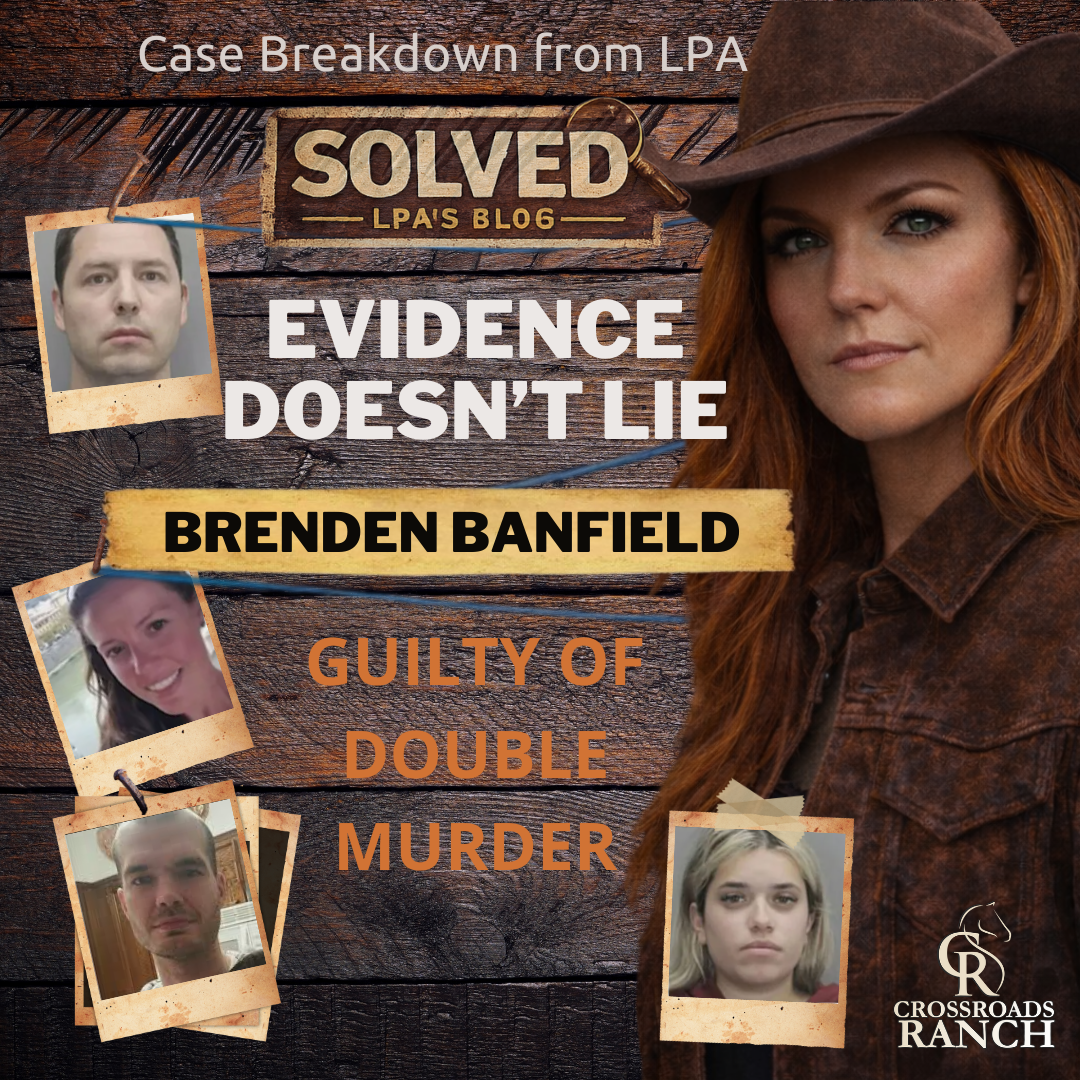
Brenden Banfield has now been found guilty. The verdict matters for justice for the victims and because of how the crime was attempted to be explained away. This was not a crime of chaos. It was a crime of Production. And the Creative failed. This case is a textbook example of why staging collapses under forensic discipline, especially method, and especially when bloodstain evidence is properly interpreted in context rather than cherry-picked and used alone.
The Narrative That He Sold…or wasn’t it…
From the outset, the scene was framed to suggest an external threat and sudden violence. The implied story relied on three assumptions (the number 1 rule of staging I always teach…we never assume anything as investigators!):
The offender was unknown
Violence was spontaneous
The scene spoke for itself
None of those assumptions held up once the evidence was slowed down and examined properly. Investigators did a good job in this case. Now, staging only works when investigators accept surface explanations, assume the integrity of the evidence, and draw premature false conclusions in the scene. This jury did not.
But What Is Staging Really?
One way it can be defined is, "staging is the manipulation of behavior and/or physical evidence to mislead investigators about what truly occurred.” And the purpose is of course to get away with murder! Staging can be subtle or bold. Monothematic or polythemaic. It is purposeful. It is deliberate. It does not happen by accident. You don’t accidentally stage a murder. And it almost always introduces contradictions. In the Banfield case, those contradictions appeared in blood, movement, and sequence…not to mention his really unbelievable performance on the stand. Stuttering. Not making sense. Word salad. Why? Because he wasn’t speaking from memory, he was trying to outfox the foxes. Foxes are very smart by the way aka Jury. :)
Blood Does Not Lie About Order
For me, Bloodstain Pattern Analysis is not about gore. I was just teaching this very concept on Saturday morning via Zoom in Panama. BPA is about physics expressed in the language of mathematics, movement, and chronology. We don’t draw conclusions based on bloodstains alone…but they tell their story regardless. Their story is just lying there waiting for someone to come along who speaks their language. I learned their language in 2003. I speak fluent Bloodstain and what they’ve taught me in my 25 years in homicide has been the most honest account of what happened to date. In the Banfield case, key indicators that undermined the staged narrative included:
Directionality mismatches: Bloodstains indicated movement and positioning that conflicted with the claimed order of events.
Void patterns: Areas conspicuously free of blood suggested bodies or objects were present and later moved.
Inconsistent distribution: The spread of blood did not align with a single, continuous assault as implied. Instead, it pointed to separate actions and repositioning.
Bloodstain pattern analysis is the study of the size, shape, location, and distribution of bloodstains. The blood told the truth. I love bloodstains for lots of reasons, such as bloodstains can answer three questions staging cannot control no matter what the offender does:
Where was the victim at the time of the attack? And where the victim was not.
When did this occur? This one relates to time, drying time, coagulation, etc.
What happened before and after? The Sequence of Events. Beautiful.
The scene alone could not answer those questions consistently in this case.
Staging Behavior Betrayed the Setup
Staging is not only physical. It is behavioral. It is psychological. It is communication: it is linguistic, it is visual, it is gestural. Pettler’s Staging Taxonomy
In this case, post-death actions conflicted with the psychology of a truly surprised or panicked victim-survivor. Timing, decisions made after the violence, and selective reactions exposed instrumental behavior, not fear-based behavior. That matters. That matters a lot. And let’s not forget in many people that fear creates disorder. Organized, sophisticated offender employ instrumentality, which creates structure. This scene had structure. Banfield is smart.
The Myth of the Perfect Crime
Pop culture sells the idea that intelligent offenders can outthink forensic science. Real cases prove the opposite. I’ve got piles of real cases that prove that one. We also must remember that staging increases complexity and complexity increases the possibility for error, and error can leave signatures. Without behavior we have no evidence… The more effort an offender puts into shaping a story, the more opportunities they create for the evidence to contradict it. That is exactly what happened here. The story was elaborate. Simple sells.
Why This Verdict Matters for Staged Cases
This conviction reinforces several critical truths about crime scene investigation, homicide investigation, and the importance of behavioral analysis in homicide cases:
Crime scenes must be read, not reacted to…this is a huge problem in CSI and investigation
Bloodstain evidence must be evaluated within full scene context, not in isolation
Staging fails when investigators resist narrative pressure, bravo!
Most importantly, it confirms that method-driven analysis beats speculation every time.
Final Takeaway
The Banfield case was not solved by instinct or theatrics. It was solved by discipline. By letting the evidence speak.
Blood does not care what story you want to tell. It will tell what actually happened.
And in this case, it told the truth.