How to Solve A Murder in 90 Seconds
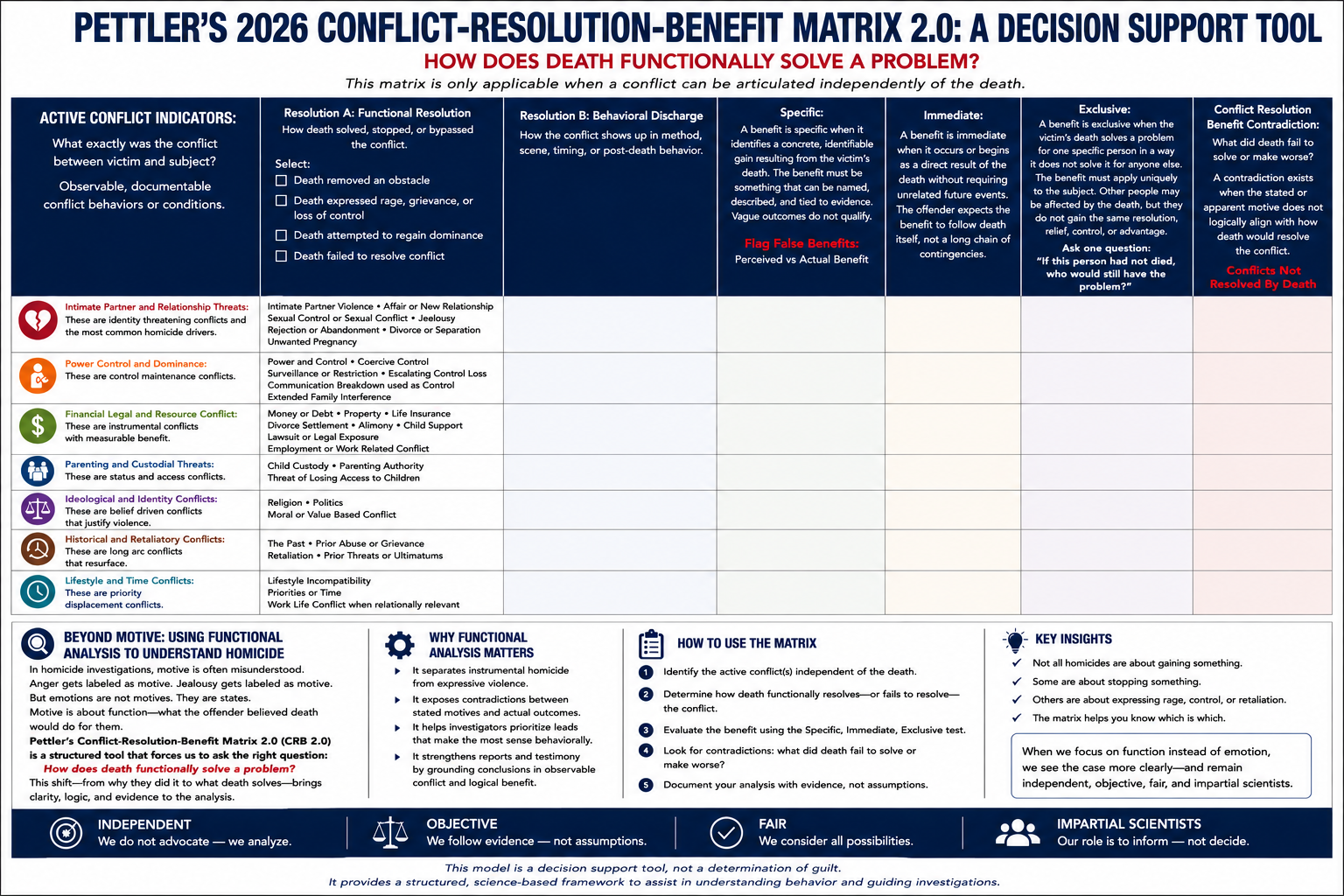
Pettler’s 2026 model: The Conflict Resolution Benefit Matrix v2.0
The hardest question in homicide investigation is often the one investigators think they already understand. Why?
Why would someone kill their spouse? Why would a parent kill a child? Why would someone murder a business partner, a lover, a friend, or a family member? For decades, investigators have been trained to chase suspects and motive. The problem is that motive is frequently reduced to emotional shorthand in most investigations, it is not the focus of the investigation at all, but it is the driving factor in the Sequence of Murder: Trigger>EMOTION>Cognition>Behavior. Lots of things can be motive for murder. Options are endless really. Anger can become motive. Jealousy can become motive. Divorce can definitely become motive. Financial stress many times becomes motive. But, you know what? Those are not actually motives. Instead, they are conditions, stressors, conflicts, and emotional states. Human beings experience those things every day without committing homicide. So the better investigative question is not simply why someone killed another. The better question is this: How did death functionally solve a problem for the offender?
I realized after all these years of using my original Conflict>Resolution>Benefit Matrix that the whole idea of form follows function really was the core of the matrix. I hadn’t really grasped that when I built it. Anyway, that question became the foundation of my new Pettler’s 2026 Conflict Resolution Benefit Matrix 2.0, which is a structured decision support tool designed to help investigators analyze homicide through conflict dynamics, offender gain, behavioral escalation, and contradiction analysis. The matrix evolved from years of active homicide casework, behavioral analysis, forensic consultation, and continuing research following the release of the original CRB framework years ago. Over time, recurring patterns began to emerge in both solved and unresolved death investigations. Certain conflicts repeatedly appeared before homicide events. Certain benefits repeatedly surfaced after death. Certain contradictions consistently exposed offender behavior that did not align with the stated narrative. I refer to the CRB as “How to Solve a Murder in 90 Seconds”. It really does work that fast.
What investigators often describe as “motive” is frequently conflict paired with functional resolution.
In many homicide cases, death removes an obstacle. It eliminates exposure. It restores control. It prevents abandonment. It removes financial strain. It stops humiliation. It silences conflict. It prevents divorce. It eliminates competition. It prevents child support. It regains dominance. The offender may not consciously articulate the process that way, but behavior often reveals it anyway. The CRB Matrix was developed to help investigators move beyond the white noise present in every investigation and toward structured behavioral analysis grounded in observable evidence and logical function. Need I mention you don’t need DNA in every case. Behavior is often more powerful and normally there is a mountain of it for the taking.
One of the most important distinctions within the matrix is the separation between functional resolution and behavioral discharge. Functional Resolution is the way a victim’s death removes, stops, or bypasses a perceived problem, threat, conflict, or obstacle for the offender. It focuses on what the offender believed death would accomplish. Some offenders kill because they believe death solves a concrete problem. Others kill as an expression of rage, grievance, retaliation, humiliation, or loss of control. Behavioral Discharge is the emotional or psychological release expressed through homicidal violence and post-death behavior. It focuses on how rage, grievance, humiliation, control, or retaliation are expressed through the act. Many homicides contain elements of both. Separating those dynamics matters because instrumental homicide and expressive homicide often produce different behavioral patterns before, during, and after death.
The matrix organizes conflict into structured categories that repeatedly appear in homicide investigations. These include intimate partner and relationship threats, power and control conflicts, financial and legal conflicts, parenting and custodial threats, ideological conflicts, retaliatory conflicts, and lifestyle displacement conflicts. Each category reflects conflict patterns commonly observed in real-world death investigations. My original version was much narrower focusing primarily on intimate partner homicide. I can see now how this matrix could be helpful in broader application.
But for example, intimate partner homicide is rarely just about “relationship problems.” More often, investigators uncover rejection, abandonment fears, jealousy, control loss, humiliation, infidelity, sexual conflict, or divorce-related identity threats. Likewise, financial homicide is often less about greed itself and more about perceived relief, access, control, inheritance, debt elimination, or the removal of an obstacle tied to resources or exposure.
This new matrix also forces investigators to confront contradictions. This is one of the most important parts of the new framework even for me because homicide frequently creates new problems instead of solving old ones. Shocking, I know. A person may claim they wanted freedom, yet the death immediately creates financial collapse, legal scrutiny, social isolation, or loss of access to children. Those contradictions matter. They help investigators evaluate whether the offender’s explanation logically aligns with the functional outcome of the death.
Really important: The Conflict Resolution Benefit Matrix does not determine guilt and it is not intended to replace forensic science, victimology, evidence analysis, or legal standards. It is a structured analytical framework designed to help investigators organize conflict behavior, offender benefit, escalation patterns, and post-death contradiction analysis in a systematic and operationally defensible way. And the most important part, the matrix also emphasizes an important principle that is often overlooked in homicide investigation. Perceived benefit matters more than actual success. Many offenders get caught before they even have a chance to benefit. An offender does not need to ultimately improve their life for the homicide to have functioned as conflict resolution in their mind. This is important to recognize. The belief that death would solve the problem may be enough to drive the behavior. Dark, for sure.
Modern homicide investigation requires more than emotional assumptions and generalized motive-suspect-wash-repeat type investigation. It requires structured thinking, behavioral analysis, evidence-based reasoning, and the willingness to examine death not only as violence, but as behavior tied to perceived function. Sometimes the clearest understanding of homicide comes not from asking why someone was angry, but from asking what problem they believed death would solve.
That’s how to solve a murder in 90 seconds.