

Finding the Horse: What Lost Person Behavior Can Teach Us About Missing and Loose Horses
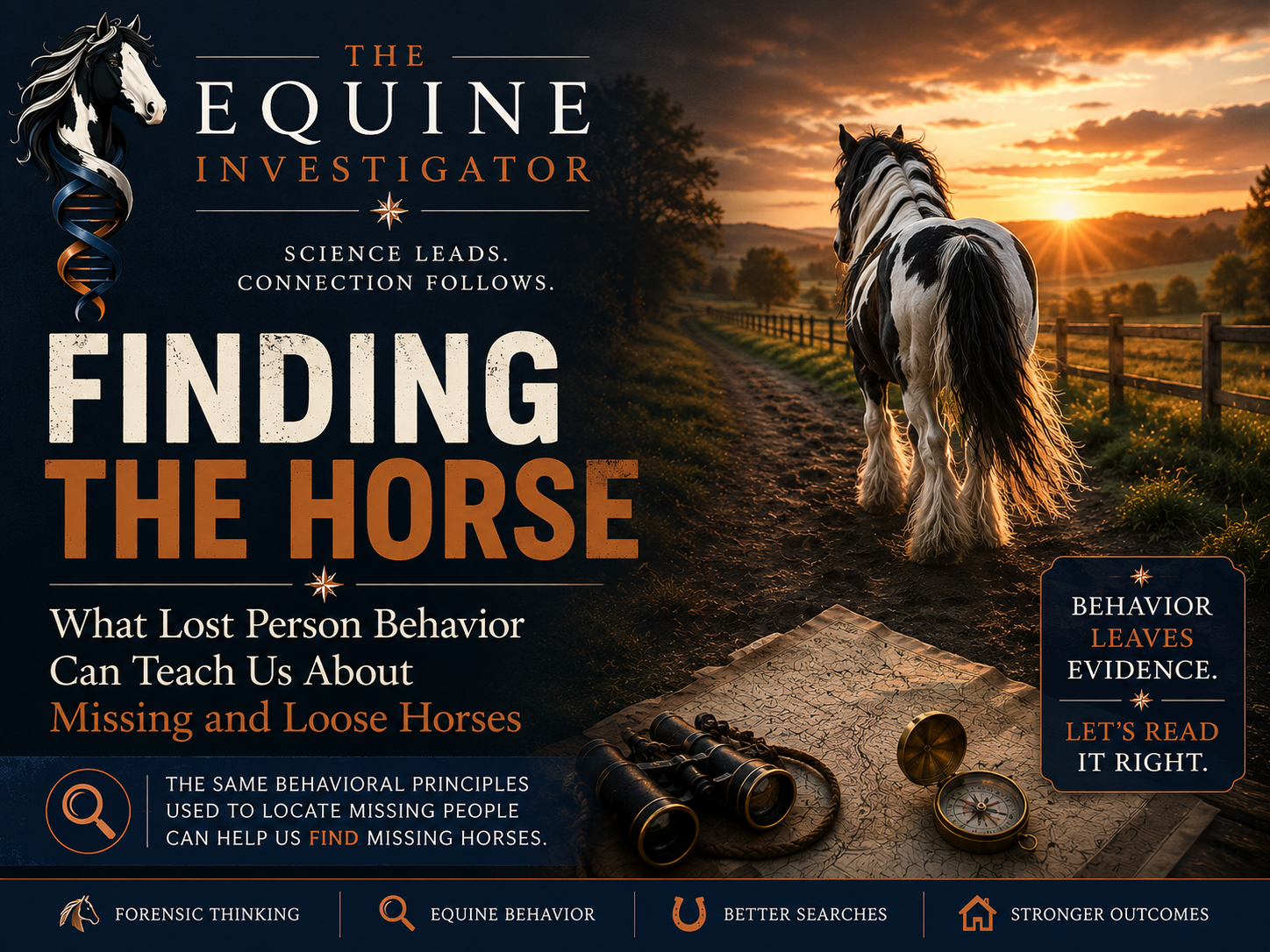
When a horse escapes, the first reaction is often panic. Owners scatter in every direction, people begin shouting names, social media lights up with sightings, and volunteers start searching wherever they think the horse might have gone. Unfortunately, horses don't think the way we do.
One of the greatest lessons I've learned working in both forensic investigation and search operations is that successful searches begin by understanding behavior—not simply geography. Search and rescue professionals have spent decades studying lost person behavior. Researchers have identified predictable patterns based upon age, experience, medical conditions, personality, environmental factors, and stress. Those patterns allow search managers to prioritize where to look first instead of relying on guesswork.
Horses deserve the same approach. As prey animals, horses make decisions based primarily on safety, familiarity, herd dynamics, terrain, and their perception of danger. They are rarely wandering aimlessly. More often, they are making logical decisions based upon the information available to them in that moment. A frightened horse that bolts from a trailer accident is not behaving the same way as a horse that slips through a pasture gate during the night. Likewise, a horse separated from its herd may behave very differently than one escaping from pain, fear, or an unfamiliar environment. Understanding why the horse left is often just as important as knowing where it left.
This is where forensic thinking becomes valuable. Investigators are trained to reconstruct events by asking what occurred immediately before the incident, what changed, and what influences behavior afterward. The same questions can dramatically improve the search for a missing horse.
What startled the horse?
Was another horse involved?
Was the horse injured?
Was it familiar with the surrounding area?
Where are the nearest sources of water, shelter, open pasture, or other horses?
What barriers would the horse naturally avoid—or attempt to cross?
Rather than treating every escape as unique, we can begin identifying behavioral patterns that improve decision-making and reduce search time. At The Equine Investigator, I believe equine investigations should extend beyond criminal cases and insurance claims. They should also include understanding equine psychology through the lens of evidence, behavior, and science. Every missing horse leaves behind a story. The environment contains clues. The horse's behavior provides evidence. Our job is to recognize those patterns before emotion causes us to overlook them.
Searching smarter doesn't remove urgency. It gives urgency direction. As forensic investigators, we often say that behavior leaves evidence. Horses are no different. The better we understand how horses think, react, and survive, the better prepared we become to find them, protect them, and ultimately bring them home safely.
But you know what the truth is beyond all of the equine psychology of the day…if there’s grass, they’ll typically stop right there.