

A Global Leader in Inventing Investigative Methods

Terms & Concepts
-
Genoenvirosocioculturalism - the confluence of sociological variables including the structure and function of society, cultural variables including traditions, beliefs, religion, customs, and achievements; and environmental variables including the geographical area of which an individual lives and operates on the biological drives, personality, cognition, emotionality, and behavior pursuant to the interrelationship between the victim and the offender that produces a reflection of the synthesized whole in the pre-crime behaviors, in the crime scene, and in the wound patterns of both the victim and offender, and in the post-crime behaviors of the offender.
-
Intimicide - The killing of a former, current, or temporary intimate partner or a member of the intimate partner’s familial or social circle by another former, current, or temporary intimate partner. Intimicide includes the murders of former or current boyfriends, girlfriends or temporary sexual partners; husbands, wives, same sex domestic partners, and the friends and family of intimate partner violence victims who are murdered because they provided shelter and/or support for intimate partner violence victims. Intimicide includes the murders between individuals who just met and became sexually intimate, like for example two people who met at a bar, left together, and then one partner kills the other partner during the encounter. Intimicide also includes individuals who were dating only briefly at the time of the murder of one by another, or intimate partners who were originally strangers, but entered into a regular sex-only intimate relationship or an extra-marital affair. The definition of intimicide can also be extended to include intimate partners who solicit or conspire to have their intimate partners murdered, because without the initiation and whatever compensation might be agreed upon, the actual hired hit man most often would never even know the victim, ever target, and especially not murder the victim without prompting by the intimate partner wanting his or her partner dead. However, intimicide is not:
The murder of a victim by a serial killer
The murder of a victim engaged in prostitution killed by a patron
The murder of a victim by a stranger during the commission of non-consensual sexual act, such as rape (i.e., sexual homicide/rape-murder)
-
Cyberstaging - predatory individuals who pose as psuedovictims. Cyberstagers go to great lengths to weaponize social media to fake illness, accident, natural disaster, violent crime, property crime, hate crimes, cybercrime, other losses, and other problems by fabricating high-drama repeated online emotionally-charged, specifically-designed anecdotal exaggerations, such as hashtags, posts, shares, comments of photos, videos, language, and other content saturated with inaccurate and misleading and/or inflammatory rhetoric, including the constant despair over the permanence of their dire state to manipulate their audiences into believing there is actually a crisis. Cyberstagers prey upon the altruism of others for the purpose of personal gain. Cyberstagers may also solicit sympathy to gain power and control over others, so together they attack the cyberstager’s targets, which enables the cyberstager to not only abuse their targets themselves, but enables them to arrange for others to abuse their targets by proxy.
The Murder Room Victim-Centered Death Investigation Method
The Murder Room Method (TMR) was born from a simple observation: information does not create understanding. In many complex investigations, enormous amounts of evidence are collected, reports are generated, interviews are conducted, and timelines are assembled, yet critical relationships between pieces of information remain hidden. Investigators often become trapped within the confines of reports, databases, spreadsheets, and linear thinking. The Murder Room Method was developed to break those barriers.
Invented by forensic criminologist Dr. Laura Pettler, The Murder Room Method is a comprehensive investigative analysis system designed to organize, visualize, evaluate, and synthesize large volumes of information in complex cases. By physically and conceptually separating investigative components into dedicated areas—including victimology, suspectology, chronology, crime scene analysis, witness information, investigative questions, and evidence evaluation—the method allows investigators to see connections, patterns, inconsistencies, and opportunities that may otherwise remain overlooked.
At the center of the process sits a roundtable, intentionally chosen over a traditional square or rectangular table. The roundtable represents collaboration without hierarchy. Every discipline, every perspective, and every area of expertise has an equal seat at the table. Complex investigations often require insights from multiple fields, and the strongest conclusions emerge when evidence is examined through an interdisciplinary and multidisciplinary lens. The roundtable encourages critical thinking, constructive challenge, and collaborative problem-solving while ensuring that no single perspective dominates the discussion.
The Murder Room Method integrates proprietary methodologies developed by Dr. Pettler, including Research-Based Forensic Victimology, the Conflict Resolution Benefit Matrix (CRB), chronology analysis, event synthesis, subject interview targeting, and investigative hypothesis testing. Together, these tools transform fragmented information into a structured framework that supports evidence-based decision making.
The method was created because Dr. Pettler recognized that investigations frequently fail not from a lack of information, but from an inability to effectively organize, evaluate, and synthesize that information. The Murder Room Method was designed to address that challenge by creating a state-of-the-art environment where facts can be examined objectively, assumptions can be tested, and investigative conclusions can be grounded in evidence rather than speculation.
Today, The Murder Room Method serves as the foundation of Laura Pettler & Associates' approach to complex investigations, providing a disciplined and innovative process for pursuing one objective above all others: the truth.
Pettler’s Mounted Forensic
Opeations System (MFOS)
Version 1.0
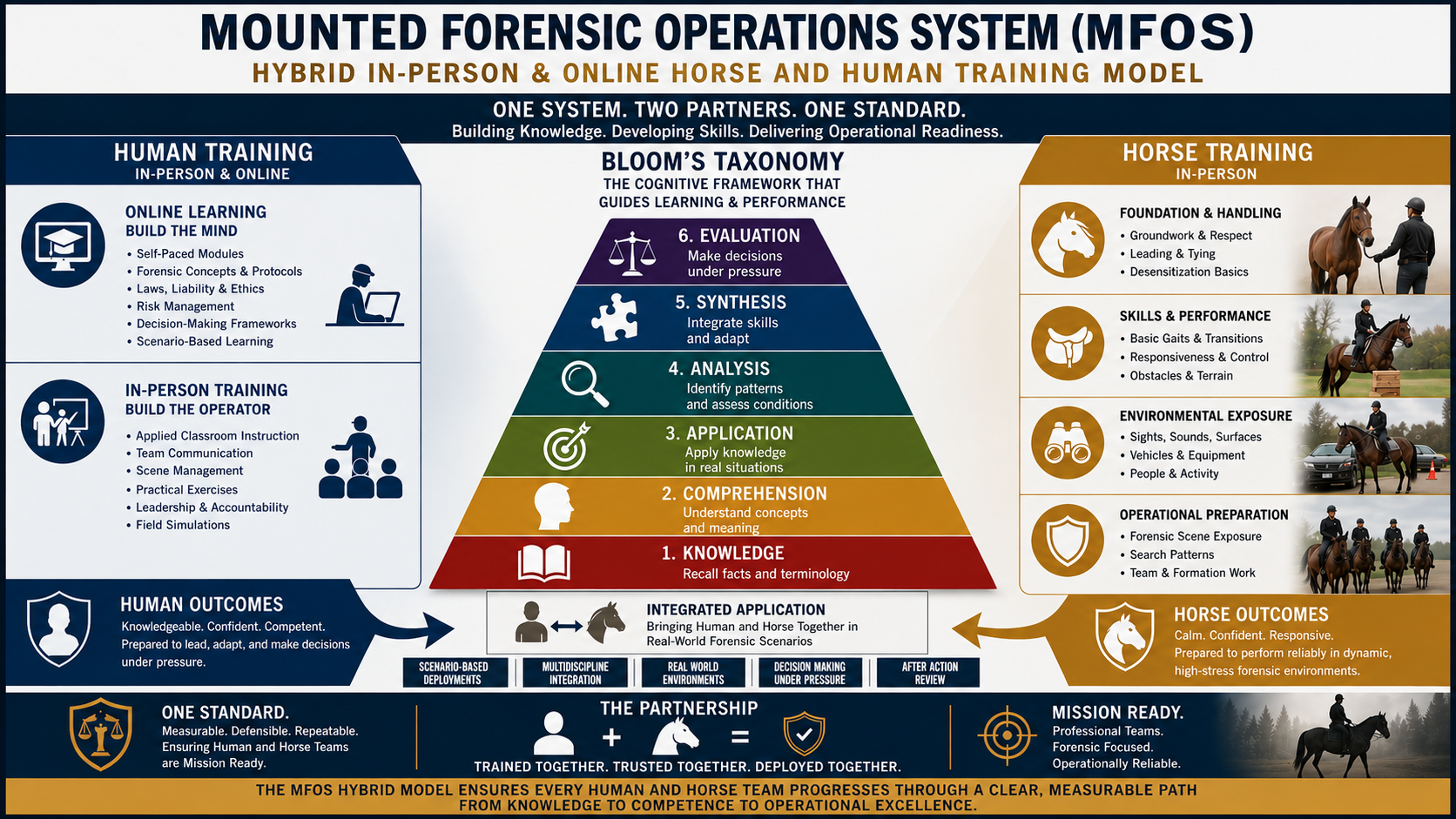
Pettler’s Mounted Forensic Operations System (MFOS) is a structured operational framework developed by forensic criminologist Dr. Laura Pettler to train sworn and civilian mounted units for forensic search, investigation, and recovery in field operations. The system integrates equitation, operational discipline, evidence awareness, and performance based training into one unified model for both horse and rider.
Unlike many mounted programs that evolve informally, MFOS was intentionally designed with measurable standards, structured progression, and operational accountability. The framework is built on four foundational pillars: Safety, Equitation, Performance, and Evidence. Together, these pillars guide the development of mounted teams capable of functioning safely and effectively under pressure.
The system uses a hybrid training model that combines online instruction, classroom education, scenario based exercises, and field application. Human training focuses on leadership, communication, decision making, and operational readiness, while horse training emphasizes responsiveness, environmental exposure, obstacle navigation, search formations, and reliability in high stimulus environments.
A defining feature of MFOS is its multidisciplinary approach of forensic science and forensic psychology. Instruction incorporates expertise from law enforcement, mounted search and rescue, forensic criminology, crime scene investigation, emergency medical services, fire service, and professional horsemanship. This collaborative model reflects the realities of modern field operations and prepares mounted teams to operate within coordinated response systems.
The first version of this system was developed and implemented in 2025 in collaboration with leadership of the Lancaster County Coroner’s Office Mounted Response Unit, the first mounted unit established within a coroner’s office in the United States. It was built, deployed, and tested within an operational environment, producing measurable and repeatable training outcomes for building Awareness-Level competencies.
Now, Pettler’s Mounted Forensic Operations System represents a modern, standards aligned approach to mounted operational readiness designed to produce mounted forensic search teams that perform with consistency, professionalism, and purpose.
Pettler’s Conflict-Resolution-Benefit Matrix
Version 1.0
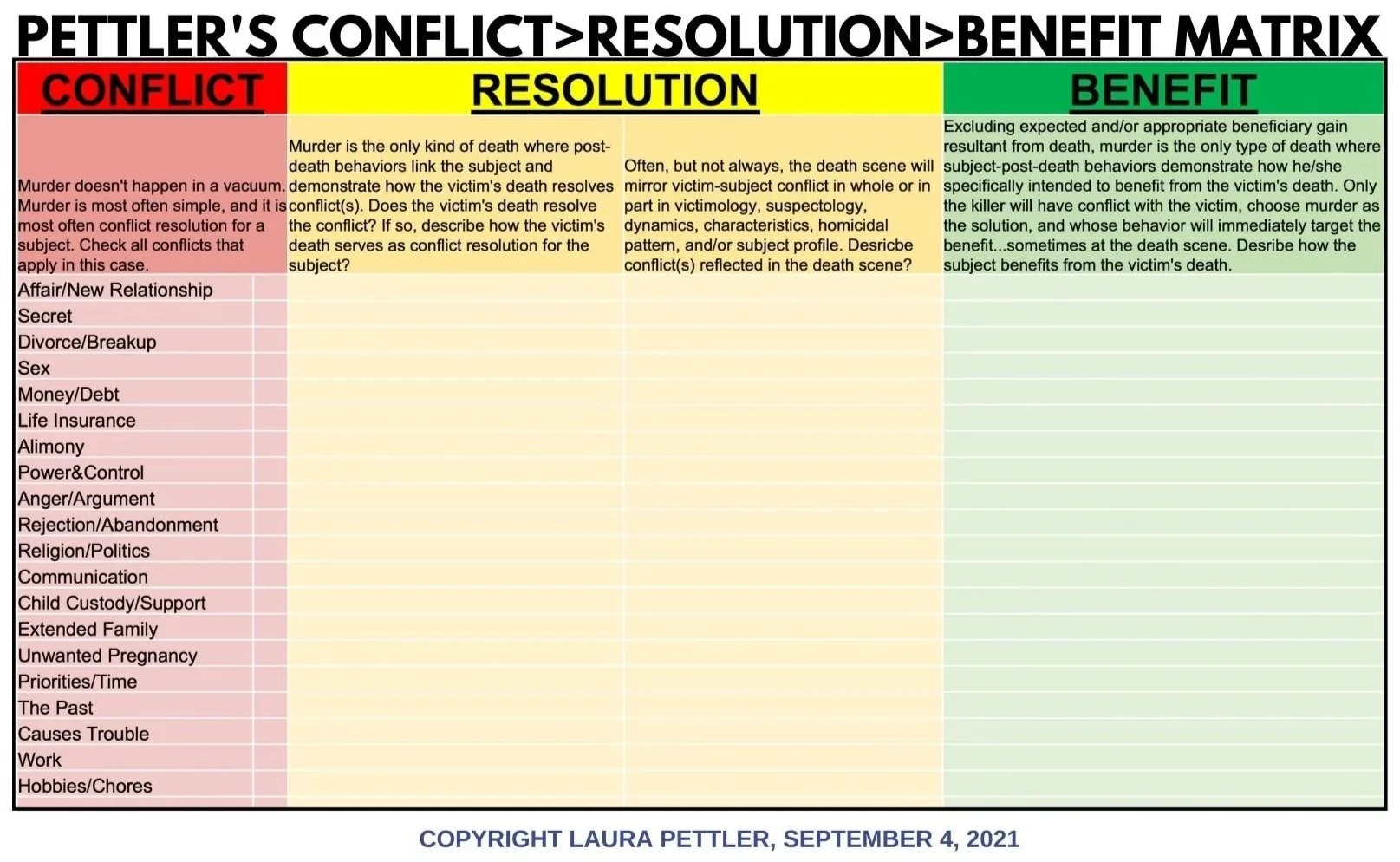
Preceding conflict has been validated as a contributor to the murder of the victim in 100% of staged murder cases. Below is Pettler's Conflict-Resolution-Benefit Matrix that synthesizes preceding decedent-subject conflict, conflict resolution, and benefit from the death of the victim. In many staged murder cases, the preceding conflict will be reflected in the death scene and resolved by how the subject benefits from the death of the decedent.
Version 2.0
The Conflict Resolution Benefit Matrix (CRB 2.0) is an investigative analysis tool developed by Dr. Laura Pettler to examine validated conflict, conflict resolution, and benefit among individuals connected to a case. Based on research demonstrating that preceding conflict was present in 100% of the staged homicide cases studied, the CRB 2.0 helps investigators identify meaningful relationships between interpersonal conflict, subsequent events, and potential outcomes. By evaluating who experienced conflict, how that conflict was ultimately resolved, and who benefited from the result, the methodology provides a structured framework for understanding motive, behavior, and decision-making within complex investigations.
Pettler’s Staging Taxonomy
Version 1.0
Pettler’s Staging Taxonomy is the world’s first staging taxonomy that explores staging behaviors in death cases as a form of communication categorizing each behavior under one of three clusters of behaviors: Linguistic, Visual, or Non-Verbal. The taxonomy is a hierarchal arrangement of interrelated behaviors aimed at helping investigators organize death investigations for staged cases to ensure they are not missing anything and that everything discovered in the investigation is mappable, trackable, and measurable. Dr. Pettler debuted her new taxonomy in March 2021 at the LPA International Forensics Institute in her 2021 Webinar Series and has since presented in internationally to the scientific community.
Version 2.0
Pettler's Staging Taxonomy 2.0 is a multidimensional behavioral classification system designed to identify, categorize, and evaluate staging behaviors encountered during death investigations, criminal investigations, intelligence gathering, internal investigations, and litigation support. Building upon the original taxonomy developed in 2021, Version 2.0 expands staging analysis beyond physical crime scenes to include linguistic, visual, and nonverbal manifestations of deception, manipulation, concealment, and misdirection.
The model provides investigators with a structured framework for classifying staging according to four dimensions: Domain, Action, Motivation, and Magnitude. By examining what type of staging occurred, how it was carried out, why it was performed, and the extent of its impact, investigators can move beyond subjective observations and toward a more systematic assessment of staged behaviors.
Unlike traditional approaches that focus primarily on altered crime scenes, Pettler's Staging Taxonomy recognizes that staging can occur through spoken statements, written communications, digital evidence, emotional displays, interpersonal interactions, environmental manipulation, and the strategic addition, removal, transformation, or destruction of information. The taxonomy allows individual staging behaviors to be classified and compared across investigations, creating a common language for investigators, attorneys, analysts, and researchers.
Whether analyzing a suspicious death, a homicide investigation, a missing person case, a fraud scheme, or a civil litigation matter, Pettler's Staging Taxonomy 2.0™ provides a repeatable framework for identifying and evaluating attempts to shape perceptions, conceal truth, redirect inquiry, delay discovery, protect interests, or manipulate outcomes.
Staging leaves patterns. Patterns reveal intent. Intent reveals truth.
Pettler’s Staging Trilogy
Version 1.0

Pettler’s Staging Trilogy is LPA’s recommended first step for investigators arriving to a death scene. Based on published empirical staging research results, preceding conflict is present in 100% of staged murder cases. Secondly, most often stagers “discover their victims” injured, dead, or missing. Third, stagers most often call 911 to report finding their victims injured, dead, or missing, even though they know all along they killed their victims themselves. Pettler’s Staging Trilogy does not solve your case by confirming your case is staged. It is a triage step every investigator should ask when they get to the scene. “Who is in conflict with this victim/decedent?” “Who discovered the victim/decedent?” and “Who called 911 and what did the caller report?”
Version 2.0
Pettler's Staging Trilogy is a rapid investigative screening framework designed to help investigators identify deaths that may warrant increased scrutiny for potential staging. Developed by forensic criminologist Dr. Laura Pettler, the model directs investigators to immediately evaluate three critical questions upon arrival at a suspicious, unexplained, or unexpected death scene:
Who was in conflict with the victim?
Who discovered the victim?
Who reported the incident to emergency services?
These three questions examine the intersection of motive, opportunity, and narrative control. Conflict identifies individuals who may possess a motive or vested interest in the victim's death. Discovery identifies those with direct access to the victim and scene. Reporting identifies the individual who controlled the first account of what allegedly occurred and established the initial narrative for first responders and investigators.
The Staging Trilogy™ is not a determination of guilt, probable cause, or criminal conduct. Rather, it serves as an investigative triage tool designed to identify circumstances that may warrant heightened scrutiny. When the same individual occupies all three positions: conflict, discovery, and reporting, the investigator has identified what Pettler refers to as a Staging Convergence Point, a circumstance in which one individual may possess motive, opportunity, and narrative control simultaneously.
The framework is intended to be used during the earliest stages of an investigation to guide investigative thinking, prioritize interviews, evaluate statements, and identify potential staging behaviors before assumptions become embedded in the investigative process.
Simple, practical, and immediately actionable, Pettler's Staging Trilogy provides investigators with a structured method for recognizing one of the most overlooked warning signs in suspicious death investigations: when the person with the greatest conflict is also the first person to discover the victim and the first person to tell the story of what happened.
Pettler’s Modified Triangulation
Pettler's Modified Triangulation Method is a proprietary analytical framework developed by Dr. Laura Pettler to evaluate the evidentiary strength of information collected during an investigation. Built upon the principle that information should not be accepted at face value, the methodology assesses whether an item of information can be supported through measures of validity and reliability. Using a three-point model, investigators examine the item in question, the evidence supporting its validity, and the evidence supporting its reliability.
Based on this analysis, information is categorized as empirical, quasi-empirical, or non-empirical. Empirical information is supported and substantiated by valid and reliable case-related data. Quasi-empirical information is only partially supported by available evidence. Non-empirical information remains unproven and unsupported by reliable case-related data. As a component of The Murder Room Method, Pettler's Modified Triangulation Method provides a structured process for distinguishing between what is known, what is partially supported, and what remains speculative, thereby strengthening the foundation for evidence-based investigative conclusions.
Pettler’s Research-Based
Forensic Victimology
Research-Based Forensic Victimology is the analytical study of victim information using a modified version of the qualitative research method triangulation grounded by the two ethical constructs of empirical research, which are validity and reliability. In empirical research, validity means the study's ability to answer the research question(s) and reliability means the ability to apply the study's results to the population for which it was designed. Analyzing all available information about a victim during the course of an investigation is critical to investigatory success. The author’s concept of research-based forensic victimology essentially implies the two of fundamental cornerstones of empirical research; validity and reliability should anchor victimological study. From a research perspective, validity generally means that the system design or method of which research is conducted is sound. On the other hand, reliability, from a research perspective generally means that the systematic design or instrument used to measure the variable produces consistent results applicable beyond the study’s sample to a broad population. The concepts of validity and reliability are by far a broader topic, but for the purpose of this discussion about research-based forensic victimology, validity is the structural soundness of the information gathering system and reliability is the applicable soundness of the information in part and as a whole. Because resources are scare in American law enforcement today, it is fair to say that it is most always impossible to validate every piece of information gathered during the course of victimology Recognizing this obstacle as real and reasonable is imperative to determining the allocation of resources towards identifying the most useful and verifiable information.
Pettler’s Chronology System
Pettler's Chronology System is a proprietary investigative analysis tool designed to reconstruct and evaluate events across the antemortem, perimortem, and postmortem periods of an investigation. Developed by Dr. Laura Pettler, the methodology organizes people, actions, communications, evidence, and critical events into a structured timeline that allows investigators to identify patterns, deviations, inconsistencies, and previously unrecognized connections. Serving as a foundational component of The Murder Room Method, the system provides a visual framework for understanding how events unfolded and supports evidence-based investigative decision-making. Its guiding principle is simple: sequence reveals patterns, patterns reveal deviations, and deviations reveal truth.
The Kaleidoscope System
Shooting & Bloodstain Analysis
Crime Scene Reconstruction System
Dr. Pettler’s Kaleidoscope Reconstruction System for bullet path and bloodstain trajectory reconstruction is the industry leader worldwide. There is literally nothing else like Kaleidoscope in the world. Kaleidoscope is the #1 go-to kit for CSIs and detectives everywhere. And LPA’s Kaleidoscope Reconstruction SUPER Store is the only crime scene reconstruction store in the world featuring
3 Shooting Recon Kits
2 Bloodstain Recon Kits
1 Combo Shooting and Bloodstain Recon Kit
11 Variations of Tubular Dowels
65 Variations of Fiberglass Dowels
Kaleidoscope is the most versatile and comprehensive shooting and bloodstain reconstruction giving users the ability to manually reconstruct scenes economically and efficiently. Laura Pettler & Associates is the only manufacturer in the world of Laura’s invention, The Kaleidoscope Reconstruction System, the most comprehensive and versatile bullet path trajectory and impact spatter bloodstain reconstruction system in the world. Stemming from a 2008 homicide in Caroleen, NC, Laura and two colleagues developed what was first known as Tubular Dowel Crime Scene Reconstruction, which Laura reinvented in 2013 and again in 2017 that is part of her Kaleidoscope System today carried by the top forensic product distributors who sell it in more than 30 countries.
Kaleidoscope Crime Scene Reconstruction 2.0
In August 2022, again at the International Forensics Conference (The IAI), this time in Omaha, Nebraska, Dr. Laura and long-time colleague, Douglas Young, Thorton Police Department Senior Criminalist and 2020-2021 President of the Association for Crime Scene Reconstruction launched the newly remodeled Kaleidoscope System. The first upgrade since 2017, Dr. Laura and Doug’s presentation of the kits met with resounding success.
History of Kaleido: It all started when…

Crime scene photo: Timothy White position using a forensic mannequin. Property of Laura Pettler.
Crime scene photo: Victim was shot five times by his wife. Shots depicted using Pettler’s Tubular Dowels, which glow. Property of Laura Pettler.
In October 2008, when Dr. Laura was working with a North Carolina Sheriff’s Office to reconstruct the murder of a man named Timothy White. Mr. White was shot in the head and twice in the back of his left hip and left leg. The district attorney asked which shot was first, second, and third. The sequence of shots was the difference between charging First Degree Murder and seeking the death penalty versus Second Degree Murder.
Back then, Laura purchased fiberglass driveway markers and wood dowels from home improvement stores, spray painted them various colors, and taped string to their ends to demonstrate bullet paths. She used lasers to show trajectories, but without the ability to shoot lasers through the dowels, often she ran into trouble. For bloodstain reconstructions, she ran into similar challenges: She also used a floor lamp stand, tape, and string to reconstruct blood in flight of bloodstain distributions. Both of these methods led to droopy strings, they were primitive, and she knew she needed to invent something new.
We use Pettler’s Kaleidoscope System and other innovative technology to reconstruct your case.
Tubular Dowel Crime Scene Reconstruction
2009, the first Kaleidoscope System was called Tubular Dowel Crime Scene Reconstruction
The first thing Laura knew needed improvement were the dowel rods for bullet path reconstruction. Spray painting wooden rods was just not cutting it. Laura wanted to shoot a laser through a dowel rod, but no dowels existed in the world of forensic science with that capability. Laura sought out a hollow dowel that would replace the solid ones. After experimenting by shooting a laser through a McDonald’s straw, Laura knew clear, hollow, dowels were the future of laser reconstruction.
With the help of so many outstanding contributors along the way, Laura launched the first “Tubular Dowel Crime Scene Reconstruction Kit” in Tampa, Florida at the 2009 International Forensics Conference (The IAI). In 2013, Laura reimagined tubular dowel crime scene reconstruction by taking her original system even further by inventing what the world knows today as Dr. Pettler’s Kaleidoscope Laser Reconstruction System.