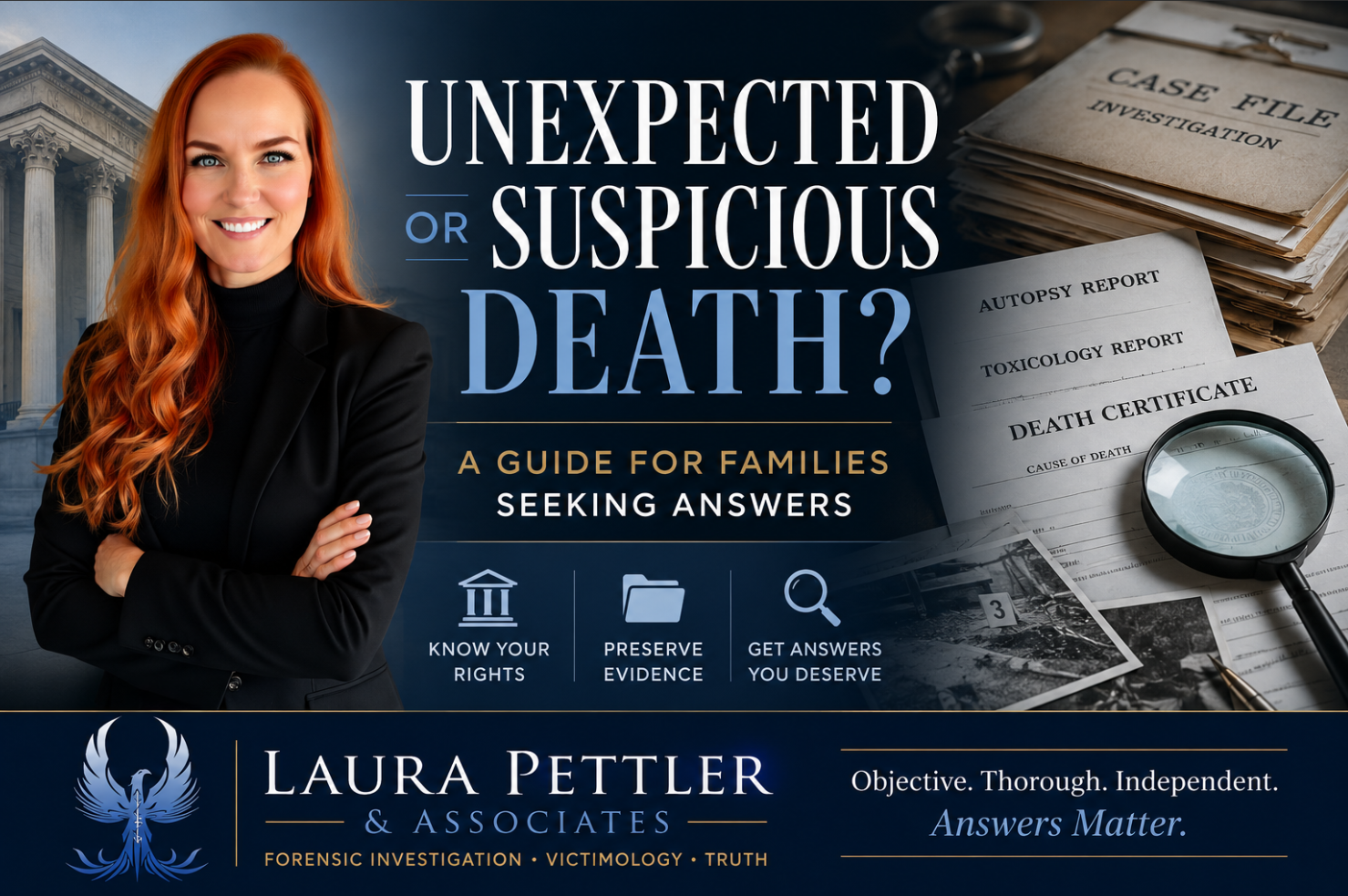

Independent forensic review for families, attorneys, and investigators
Suspicious Death Investigation & Crime Scene Staging Review
When a death is unexpected, unexplained, disputed, or suspicious, families and attorneys are often left with serious questions. Laura Pettler & Associates provides independent forensic review, crime scene staging analysis, equivocal death analysis, and death investigation consultation. Our role is not to force a theory. Our role is to evaluate the evidence, identify unanswered questions, and follow the facts wherever they lead.
What To Do When a Death Seems Suspicious
The sudden loss of a loved one is devastating. When the circumstances surrounding the death are unexpected, disputed, unexplained, or suspicious, the grief is often made worse by unanswered questions. Before hiring a private investigator or forensic consultant, families should strongly consider speaking with a qualified attorney. An attorney can help protect legal rights, preserve important records, request documents, communicate with agencies, and determine whether an independent forensic review may be needed.
Important first steps:
Do not disturb, move, or discard potential evidence.
Save text messages, photos, videos, emails, social media posts, and voicemails.
Write down questions while details are still fresh.
Request copies of available reports through proper legal channels.
Consult with an attorney before sharing sensitive information publicly.
What Is a Suspicious Death Investigation?
A suspicious death investigation reviews a death where the facts, evidence, circumstances, or official conclusions raise legitimate concerns. These cases may involve a questionable suicide, disputed accident, unattended death, suspected homicide, possible staging, or an undetermined manner of death. An independent suspicious death review may examine scene photographs, autopsy reports, toxicology findings, police reports, 911 records, witness statements, digital evidence, timelines, injury patterns, and prior relationship history. The purpose is to determine whether the evidence supports the stated manner of death or whether additional investigation, expert review, or legal action should be considered.
What Is Crime Scene Staging?
Crime scene staging occurs when someone alters a scene to mislead investigators. In death investigations, staging may be used to make a homicide appear to be a suicide, an accident, a natural death, or an overdose. Staging can involve moving the body, placing or removing objects, changing the position of a weapon, cleaning blood evidence, creating a false suicide note, deleting messages, or giving misleading statements about what happened. Crime scene staging analysis requires a careful comparison of the physical evidence, injury patterns, scene layout, behavioral history, digital evidence, and timeline of events.
Staged Suicide
A staged suicide may occur when a homicide is made to look self-inflicted. Red flags may include inconsistent injuries, unusual weapon placement, missing digital evidence, or a scene that does not match the person’s known behavior.
Staged Accident
A staged accident may involve changing the scene so the death appears accidental. These reviews often require close attention to injuries, environmental evidence, timing, and witness accounts.
Common Warning Signs of a Staged or Questionable Death Scene
No single sign proves that a death was staged or misclassified. Concerns should be evaluated by looking at the totality of the evidence. The findings appear inconsistent with the person’s lifestyle, relationships, risk factors, or behavioral history. The family continues to have significant unanswered questions after the case is closed. The death was ruled a suicide, accident, or natural death despite unresolved concerns. The circumstances do not match the injuries. The scene appears inconsistent with the reported events. Family members received conflicting explanations from different sources. Important evidence was not collected, documented, preserved, or reviewed. Witness statements changed over time. New information surfaced after the investigation ended. There are concerns about a possible staged crime scene.
Homicide, Suicide, Accident, Natural, or Undetermined?
Death investigations often involve determining the manner of death. The commonly recognized categories are homicide, suicide, accident, natural, and undetermined. Families may question a ruling when the manner of death does not match the evidence, when the investigation appears incomplete, or when key information was not considered. An independent forensic review can help identify whether the available facts support the official conclusion.
Equivocal Death Analysis and Independent Case Review
An equivocal death is a death where the manner is unclear, disputed, or difficult to determine. Equivocal death analysis is a structured review of the known evidence, investigative documentation, medical findings, behavioral history, and timeline. This type of review may be appropriate when a case involves a questionable suicide, suspected staged homicide, disputed accident, unattended death, or conflicting forensic findings. An independent death investigation review may help families, attorneys, and investigators understand what was done, what may have been missed, and what questions remain unresolved.
When Families Should Request a Second Look
Families often seek help after they are told a case is closed but still have unanswered questions. A second look may be appropriate when the official explanation does not make sense, when important evidence was overlooked, or when the family believes the death was not fully investigated. The goal of an independent review is not to guarantee a different conclusion. The goal is to review the evidence objectively and determine whether the facts support the original findings.
Have unanswered questions about a loved one’s death?
If you believe a death was not fully explained, properly investigated, or accurately classified, you do not have to navigate the process alone. Speak with an attorney first, then contact Laura Pettler & Associates for an independent suspicious death investigation review.
Contact Laura Pettler & Associates
How Attorneys Use Suspicious Death Case Reviews
Attorneys may request a suspicious death case review in civil litigation, criminal defense, wrongful death claims, insurance disputes, estate matters, and family-requested investigations. A forensic consultant can help identify evidence issues, review investigative documentation, evaluate scene findings, prepare questions for further inquiry, and explain complex forensic concepts in clear language. When appropriate, expert review may support legal strategy, deposition preparation, mediation, trial preparation, or additional investigative requests.
Death Scene Investigation, Evidence Review, and Case Consultation
Each case is different, but an independent death investigation review may include:Initial consultation with the attorney or authorized family representative. Review of case background, concerns, and available records. Assessment of police reports, autopsy reports, photographs, medical findings, and timelines. Crime scene staging analysis, when the scene appears inconsistent with the reported events. Identification of unanswered questions, missing records, or potential investigative gaps. Written findings, consultation, or expert support depending on the case needs.
Why Experience Matters in Suspicious Death Investigations
Suspicious death investigations require more than general investigative experience. These cases may involve forensic evidence, injury interpretation, victimology, crime scene reconstruction, behavioral analysis, timeline review, and staged crime scene detection.
About Dr. Laura Pettler
Dr. Laura Pettler and Laura Pettler & Associates provide forensic death investigation consultation, crime scene staging analysis, equivocal death review, and expert support for families, attorneys, and investigators.
Related Forensic Consulting Services
Forensic criminology and criminalistics expertiseIndependent death investigation services
Crime scene reconstruction methodsCourt-qualified expert witness testimony
Death investigation consulting for attorneys and families
Staged crime scene analysis
Request a confidential consultation
Frequently Asked Questions About Suspicious Death Investigations
What is a suspicious death investigation?
A suspicious death investigation reviews deaths that appear unexplained, inconsistent, disputed, or possibly misclassified. The review may include scene evidence, autopsy findings, records, witness statements, and investigative reports.
What is crime scene staging?
Crime scene staging occurs when a person manipulates a death scene to mislead investigators about what happened, who was involved, or whether the death was homicide, suicide, accident, natural, or undetermined.
How can you tell if a death scene was staged?
Possible signs include inconsistent injuries, unusual object placement, missing evidence, changed statements, a timeline that does not fit, or a scene that does not match the reported events.
What is equivocal death analysis?
Equivocal death analysis is a structured review used when the manner of death is unclear or disputed. It evaluates physical evidence, behavioral evidence, forensic findings, and investigative documentation.
Can a homicide be staged as a suicide?
Yes. Some offenders attempt to stage a homicide as a suicide, accident, or natural death. Detecting staging requires careful review of the scene, injuries, evidence, statements, and timeline.
Can a suicide be staged to look like an accident?
Yes. The scene may be altered to create a false appearance. A forensic review looks at whether the physical evidence and behavioral history support the reported manner of death.
When should a family request an independent death investigation review?
A family should consider an independent review when the findings do not match the evidence, the investigation appears incomplete, key questions remain unanswered, or legal counsel recommends additional forensic analysis.
How do attorneys use suspicious death case reviews?
Attorneys may use independent reviews to evaluate evidence, identify investigative gaps, support wrongful death claims, prepare for litigation, or determine whether additional expert review is needed.
What is an unattended death?
An unattended death is a death that occurs when no one is present or when the person is not discovered right away. These cases may require careful forensic review to determine what happened.
What does a death investigation consultant do?
A death investigation consultant reviews records, scene evidence, forensic findings, timelines, and investigative reports to help families, attorneys, and investigators understand the evidence and unresolved questions.
Speak With a Suspicious Death Investigation Expert
If a loved one’s death feels unexplained, incomplete, or inconsistent with the facts, you deserve clear answers. Laura Pettler & Associates provides independent suspicious death investigation review, crime scene staging analysis, equivocal death analysis, and forensic death investigation consultation. Consult with qualified legal counsel first. If your attorney believes an independent forensic review may be beneficial, Laura Pettler & Associates may be available to assist.
Laura Pettler & Associates | Independent Forensic Death Investigation Consultation.
This page is informational and does not provide legal advice. Families should consult with qualified legal counsel regarding their rights and available options.