

Pettler’s Mounted Forensic Operations System (MFOS)
Professional Mounted Unit Development
One System. Two Partners. Three Scientific Disciplines.
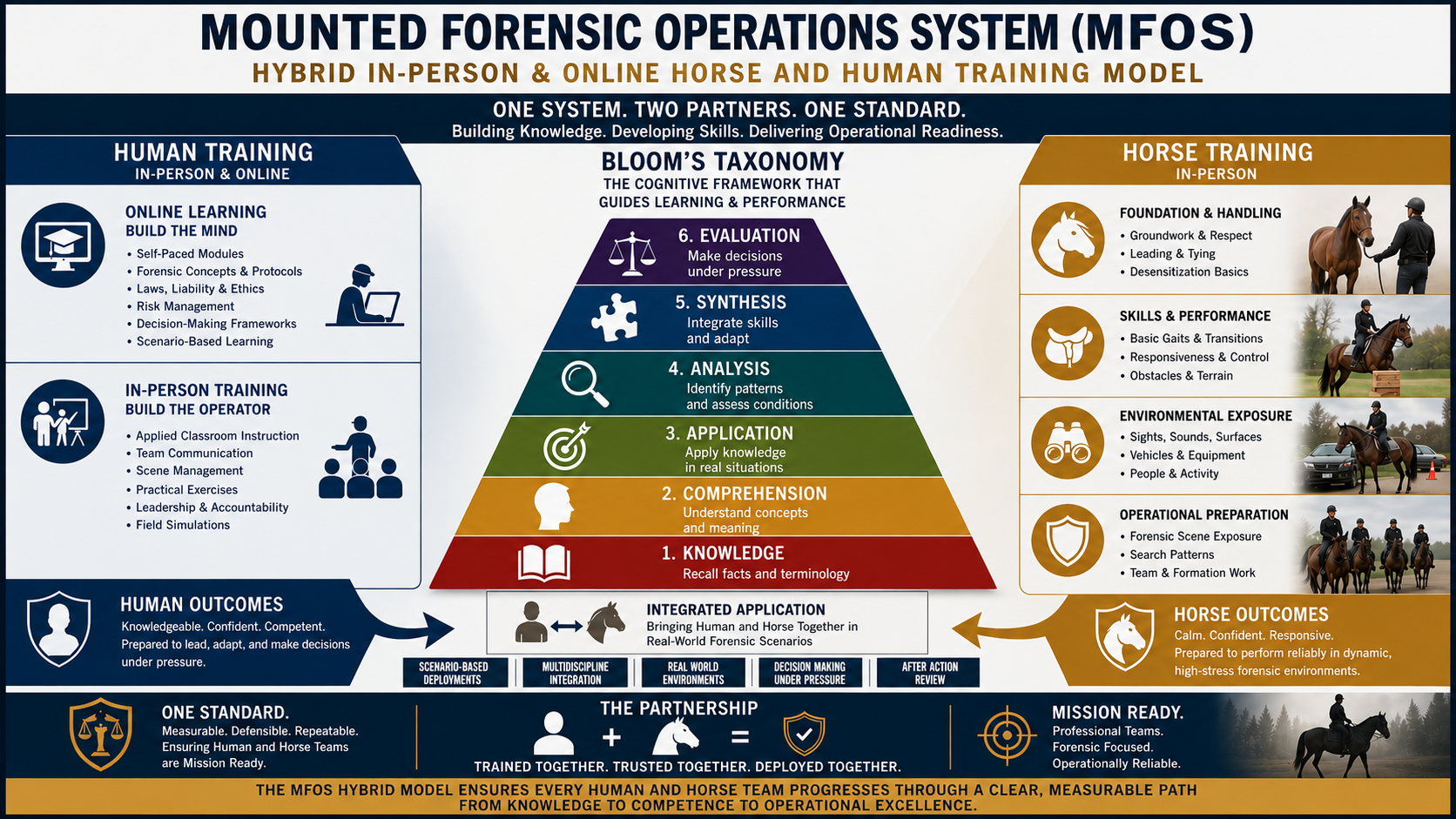
Pettler’s Mounted Forensic Operations System (MFOS) is a multidisciplinary training program that integrates three scientific disciplines into professional mounted operations: forensic science, forensic psychology, and equine psychology. Combined with established search and rescue and equipment principles, nationally recognized mounted police training, and competency-based education, these disciplines provide the foundation for developing professional Mounted Forensic Search Teams that would qualify to join mounted units from local to federal, volunteer, and civil non-profits. MFOS is not a mounted unit, it is a training program that trains horses and riders to become Mounted Forensic Search Teams using a multidisciplinary, collaborative approach.
Traditional mounted programs emphasize horsemanship, search techniques, and operational deployment. MFOS expands upon these essential capabilities by teaching mounted searchers not only how to conduct a search, but also how to understand the behavior of the people they are searching for, recognize and preserve potential evidence, understand the psychological factors influencing their own performance, interpret equine behavior, and make informed operational decisions in complex environments.
Forensic science introduces the principles of death investigation, evidence recognition, scene preservation, human tracking, and the protection of investigative integrity. Forensic psychology examines lost person behavior, suicidology, applied victimology, and the behavioral factors influencing missing persons investigations. Searcher psychology addresses cognitive bias, situational awareness, stress, decision-making, and the psychological demands of search and recovery operations. Equine psychology develops the searcher's understanding of how horses perceive, process, learn, and respond to environmental stimuli, stress, and human communication.
Together, these disciplines create a comprehensive approach to mounted searching, reconnaissance, recovery, and investigative support.
Developed by Dr. Laura Pettler, MFOS is designed for law enforcement, volunteer, and civilian mounted units. It combines scientific education, professional horsemanship, organizational development, practical field training, and measurable performance standards to prepare horse-and-rider teams for coordinated operations with law enforcement, emergency management, search and rescue, and other authorized agencies.
“MFOS trains the human to understand the mission, the horse to perform within it, and the partnership to operate as one team.” —Dr. Laura Pettler
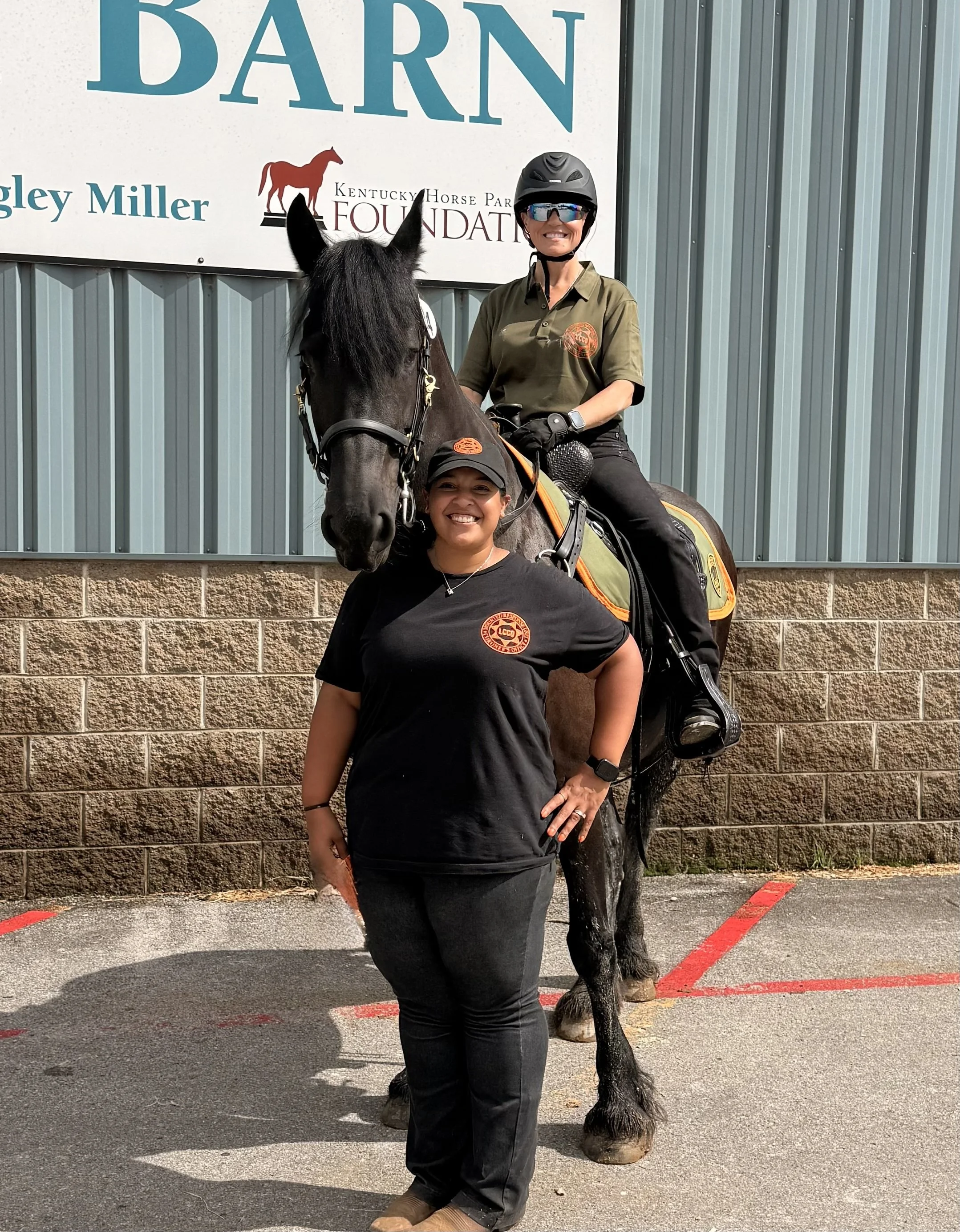
Dr. Pettler & Kismet, with Vice President of LPA, Alexis Pettler at Kentucky Horse Park.
Dr. Laura Pettler and her Mounted Response Unit mare, Kismet, salute at the National Mounted Police Colloquium at the Kentucky Horse Park.
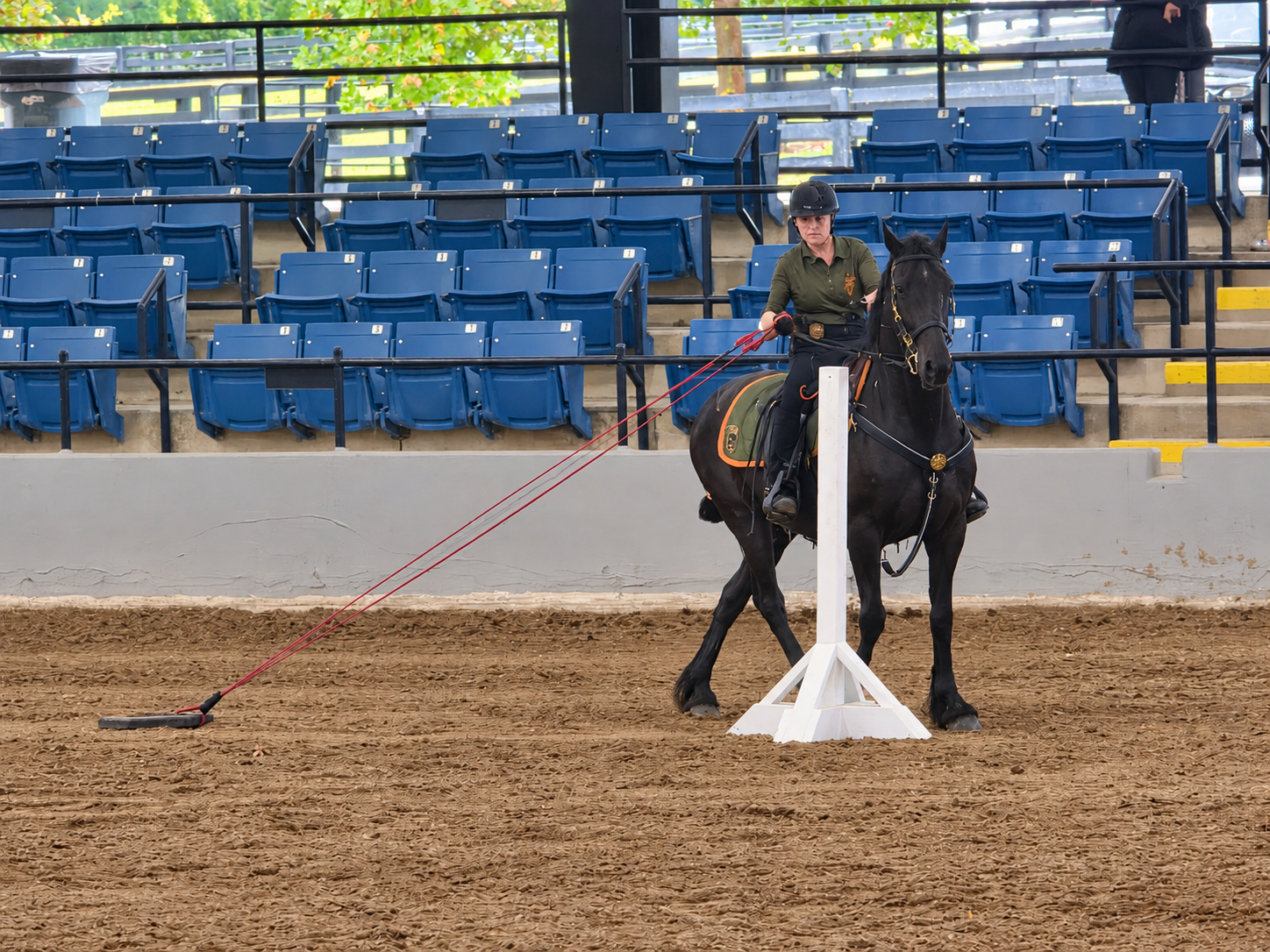
Dr. Laura Pettler and Kismet complete a dragging obstacle at the National Mounted Police Colloquium, practicing controlled movement while pulling an object behind the horse.
Dr. Pettler & Kismet, first row, second from left, train in formation for riot & crowd control to escort a Dignitary’s Vehicle out of an “imaginary” sea of 100,000 people to safety.
The MFOS Operational Partnership
One System. Two Partners. One Mission.
Pettler's Mounted Forensic Operations System establishes a unified professional identity for the human, the horse, and the operational partnership they form. Within MFOS, the Mounted Forensic Searcher is the trained human professional responsible for applying search and rescue principles, forensic science, forensic psychology, searcher psychology, and operational decision-making in the field.
The Forensic Search Horse is the equine partner developed through structured horsemanship, equine psychology, environmental conditioning, and competency-based training to perform safely and reliably in designated operational environments.
Together, the Mounted Forensic Searcher and Forensic Search Horse form a Mounted Forensic Search Team, combining human investigative knowledge, behavioral understanding, and decision-making with the horse's mobility, sensory capabilities, and specialized training.
Multiple teams may operate within a Mounted Forensic Operations Unit, an organized program with defined leadership, operational responsibilities, training standards, equipment requirements, and deployment protocols.
These designations establish a consistent professional vocabulary throughout MFOS while recognizing that the capabilities of the individual searcher, the horse, and the combined team must each be developed and evaluated. Once complete, units develop their own terms for how they refer to their horses and riders. The objective is to prepare Mounted Forensic Search Teams capable of supporting authorized search, recovery, reconnaissance, and investigative operations through a coordinated, scientifically informed approach.
Build Your Mounted Forensic Operations Unit
Building a professional mounted unit requires more than experienced riders and well-trained horses. It requires a clearly defined mission, organizational structure, standardized training, appropriate equipment, measurable performance benchmarks, and the ability to operate safely and effectively alongside other agencies.
MFOS provides an established training and operational framework that organizations can adapt to their missions, personnel, geographic environments, and available resources. Rather than developing training programs, operational procedures, and evaluation systems independently, organizations can implement a coordinated model that integrates human education, equine development, and operational readiness.
The system is designed to support the establishment of new Mounted Forensic Operations Units and the professional development of existing teams, with particular emphasis on safety, forensic awareness, behavioral understanding, operational discipline, and risk reduction.
Unit Development & Implementation
A structured foundation for building professional mounted operations.
Mission development and operational scope
Organizational structure, leadership, and unit responsibilities
Standard operating procedures and operational protocols
Mounted Forensic Searcher and Forensic Search Horse suitability assessments
Nationally recognized mounted SAR training and equipment standards
Forensic science, forensic psychology, searcher psychology, and equine psychology education
Training curricula and measurable competency benchmarks
Equipment, safety, and deployment preparation
Performance evaluations and qualification pathways
Interagency coordination and operational integration
MFOS can be adapted to an organization's geographic location, terrain, climate, resources, and intended missions. Whether supporting missing person searches, recovery operations, public safety assignments, or forensic investigative activities, each implementation establishes defined responsibilities and operational expectations appropriate to the organization's authority and capabilities.
Three Scientific Disciplines.
One Operational System.
Forensic Science
Understanding the Evidence. Protecting the Investigation.
Mounted Forensic Searchers can cover substantial areas of terrain, but their elevated position, speed of travel, and the physical movement of their horses introduce important considerations for evidence recognition and preservation. MFOS incorporates forensic science to teach searchers how to recognize potential evidence, identify disturbances in the environment, understand human tracking principles, preserve scene integrity, and avoid compromising investigative findings. Instruction addresses the relationship between searching, crime scene reconstruction, and death investigation, including the responsibilities of mounted personnel when encountering human remains, potential crime scenes, or other evidence requiring specialized investigative response. Searchers learn to recognize the limitations of their roles, protect potential evidence from contamination, and communicate observations to appropriate investigative authorities.
Forensic Psychology
Understanding the Missing Person. Understanding the Searcher.
MFOS incorporates forensic psychology and related behavioral sciences through two complementary areas of study: the psychology of the individual being sought and the psychology of the searcher conducting the operation.
Lost Person Behavior and Investigative Psychology
Search effectiveness depends in part on understanding the behavior and circumstances of the person being sought. MFOS integrates lost person behavior, suicidology, applied victimology, and behavioral considerations relevant to missing person investigations. Mounted Forensic Searchers examine how individual characteristics, psychological states, medical conditions, environmental circumstances, and situational factors may influence a missing person's decisions, movement, responses, and potential location. This knowledge helps mounted personnel understand search objectives, recognize behaviorally significant information, and contribute more effectively to coordinated search planning and field operations.
Searcher Psychology and Human Performance
The psychological state of the searcher can be just as consequential to operational performance as the behavior of the individual being sought. MFOS incorporates principles of cognitive psychology, operational psychology, and human factors to examine how searchers perceive, interpret, and respond to information under field conditions. Instruction addresses cognitive bias, confirmation bias, attentional tunneling, situational awareness, stress responses, decision fatigue, expectancy effects, and decision-making under uncertainty. Searchers also examine the psychological demands of prolonged searches, unsuccessful missions, traumatic discoveries, encounters with human remains, and emotionally challenging interactions with victims and families.
Particular attention is given to the relationship between psychological state and operational judgment. Expectations can influence what searchers notice, overlook, or interpret as significant. Stress and fatigue may affect attention, communication, memory, and decision-making. Understanding these influences helps personnel recognize their own limitations, maintain operational discipline, and make more informed decisions.
For Mounted Forensic Searchers, human psychology also intersects directly with equine behavior. Changes in rider tension, attention, communication, and emotional regulation can influence the horse's responses, while unexpected equine behavior can affect the rider's perceptions and decisions. MFOS examines these interactions to develop greater awareness of how human psychological processes influence the safety, effectiveness, and reliability of mounted operations.
Equine Psychology
Understanding the Horse. Developing the Partnership.
A Forensic Search Horse is not simply transportation. The mounted forensic searcher, should be at no time just a passenger looking around. Rather, the horse is a living, thinking, sensory partner whose behavior directly influences the safety and effectiveness of mounted operations. And they are prey animals.
MFOS incorporates equine psychology, learning theory, and behavioral science to develop a greater understanding of how horses perceive their environments, respond to unfamiliar stimuli, communicate through behavior, and perform under stress.
Instruction emphasizes the development of confidence, trust, responsiveness, adaptability, and behavioral regulation through appropriate training and conditioning. Mounted Forensic Searchers learn to recognize behavioral indicators that may affect operational performance and to make informed decisions that protect both horse and rider.
MFOS also examines the reciprocal relationship between horse and rider. Horses respond to human cues, learned associations, environmental conditions, and changes in their handlers' behavior. Riders must learn to distinguish between ordinary equine responses, potential environmental concerns, and behaviors that require further assessment.
Understanding equine psychology enables Mounted Forensic Searchers to develop more effective communication, recognize changes in their horses' behavior, and maintain reliable partnerships during complex or high-pressure assignments.
Forensic Horsemanship: Four Foundational Pillars
Pettler's MFOS incorporates four foundational pillars of forensic horsemanship that guide the development and evaluation of Mounted Forensic Search Teams.
Safety: Establishing the knowledge, procedures, situational awareness, and practical skills necessary to reduce risk to horses, riders, other personnel, and the public.
Equitation: Developing effective horsemanship, mounted control, communication, and the human-equine partnership through sound training principles and an understanding of equine behavior.
Performance: Evaluating the ability of Mounted Forensic Search Teams to apply their training under pressure, navigate environmental challenges, manage psychological and environmental stressors, maintain operational discipline, and complete assigned tasks safely and consistently.
Evidence: Developing the forensic knowledge and observational skills necessary to recognize, document, and preserve potential evidence while protecting the integrity of investigative and recovery operations.
These pillars provide a consistent framework for evaluating the capabilities of both partners and their performance together.
The MFOS Hybrid Training Model
Developing the Human. Training the Horse. Evaluating the Partnership.
Operational readiness depends upon the capabilities of both the Mounted Forensic Searcher and the Forensic Search Horse. MFOS integrates their development through a hybrid educational model combining online instruction, in-person training, scenario-based exercises, and practical field application.
Mounted Forensic Searcher Education: Human education incorporates forensic science, forensic psychology, searcher psychology, search and rescue fundamentals, leadership, decision-making, communication, risk management, and operational procedures. Participants develop the knowledge required to understand their assignments, interpret information critically, recognize cognitive and psychological influences on performance, and make informed decisions in the field.
Forensic Search Horse Training: Equine training incorporates equine psychology, learning theory, foundational handling, responsiveness, environmental conditioning, obstacle navigation, search formations, and preparation for operational stressors. Horses are progressively developed and evaluated for suitability, reliability, and performance in their intended assignments.
Mounted Forensic Search Team Training: Partnership training brings these capabilities together through practical exercises and operational scenarios that assess communication, coordination, safety, situational awareness, decision-making, and mission performance. Training examines how human and equine behavioral responses interact and influence the effectiveness of the mounted team.
Using Bloom's Taxonomy as an educational framework, MFOS supports progressive learning from foundational knowledge and comprehension through application, analysis, synthesis, and evaluation. Training emphasizes the practical transfer of knowledge and skills into operational environments.
Professional Training & Certification
MFOS uses progressive, competency-based training and performance evaluation to develop Mounted Forensic Search Teams to prepare participants for appropriate external accredited certification programs.
SARTECH III: The Core Search and Rescue Foundation
The National Association for Search and Rescue (NASAR) SARTECH III program serves as the foundational search and rescue component of MFOS. Its entry-level, non-wilderness operational curriculum provides essential knowledge for supporting organized searches in community environments.
MFOS builds upon this foundation through specialized instruction in forensic horsemanship, forensic science, forensic psychology, searcher psychology, equine psychology, mounted reconnaissance, mounted searching, evidence preservation, and coordinated field operations. Participants progress through education, practical training, and performance assessments appropriate to their intended operational roles.
At minimum to be a mounted search and rescuer, LPA recommends the SARTECH III certification program. SARTECH III establishes a starting point for continued development. Completion of foundational search and rescue education does not independently establish mounted operational readiness. Mounted Forensic Search Teams require additional preparation, demonstrated competencies, and appropriate authorization before participating in operational assignments. MFOS also supports preparation for applicable NASAR and other recognized training and certification pathways, with the goal of developing knowledgeable, competent, and accountable mounted personnel.
MFOS Developed Through Practical Application
The original version of Pettler's mounted training methodology was developed and implemented in 2025 through Dr. Laura Pettler's work with the Lancaster County Coroner's Office Mounted Response Unit.
During the unit's inaugural year, Dr. Pettler served as the unit’s Deputy Coroner Commander and developed a structured program incorporating online education, in-person training, horse-and-rider aptitude testing, practical exercises, and performance evaluations. By November 2025, six horse-and-rider teams had successfully completed Pettler's original awareness-level mounted search and rescue certification program.
Building upon that implementation, Dr. Pettler developed the next generation of her methodology: Pettler's Mounted Forensic Operations System. MFOS expands her original framework through a more comprehensive integration of forensic science, forensic psychology, searcher psychology, equine psychology, professional mounted training, and operational development. Today, MFOS is an independently developed professional training and operational framework available to law enforcement, volunteer, and civilian organizations seeking to establish or advance their mounted capabilities.
Learn more about the educational foundation of Pettler's Methods at LPAIFI.com.
Bring MFOS to Your Organization
Build Your Unit. Establish Your Standards. Prepare for the Mission.
Pettler's Mounted Forensic Operations System provides organizations with a structured pathway from initial unit development through scientific education, equine training, practical field exercises, performance evaluation, and operational preparation.
Laura Pettler & Associates works with organizations to identify their missions, evaluate training and development needs, and establish implementation plans appropriate to their operational environments and objectives. Whether building a new Mounted Forensic Operations Unit or strengthening an existing organization, MFOS provides a multidisciplinary approach to developing capable Mounted Forensic Search Teams grounded in scientific knowledge, professional standards, behavioral understanding, and measurable performance.
For information about enrolling in the MFOS training program, on-site program implementation, training opportunities, and certification pathways, contact Laura Pettler & Associates.
Program Instructors: LPA subject-matter experts, local, state, and federal law enforcement instructors, internationally recognized search and rescue instructors, and world-champion horse trainers.