

Welcome to The Briefing Room
The Briefing Room is where current cases, forensic analysis, investigative commentary, behavioral evidence, victimology, and media narratives are examined through the lens of science and investigative methodology. From breaking developments to overlooked details, this is where evidence comes first.
The Briefing Room exists to challenge assumptions, explore emerging investigative methods, and encourage collaboration in the pursuit of truth. Because truth doesn't care where the good idea came from.


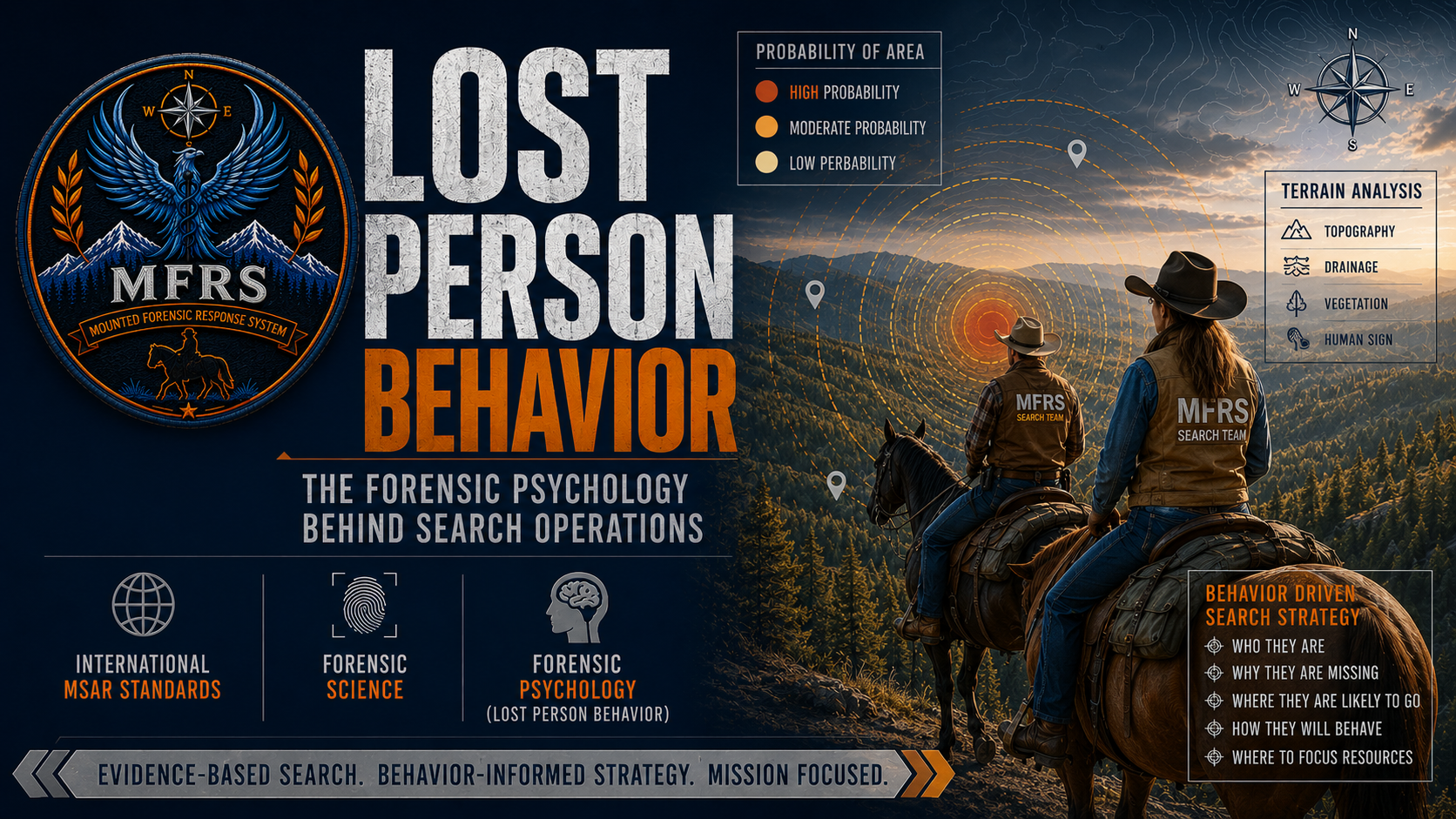
Why Lost Person Behavior Matters: The Forensic Psychology Behind the Mounted Forensic Operations System (MFOS)
When most people think about search and rescue, they picture searchers walking through the woods, helicopters flying overhead, K9 teams tracking scents, or mounted teams covering vast stretches of difficult terrain. What many people do not realize is that successful search operations begin long before the first hoofprint, boot print, or tire track enters the field.
They begin with human behavior.
At the heart of the Mounted Forensic Response System (MFRS) is a principle that separates effective searches from random searching: understanding how and why people become lost. This discipline, commonly known as Lost Person Behavior (LPB), combines decades of research, forensic psychology, statistics, and field experience to help search managers make informed decisions about where a missing person is most likely to be found.
The goal of a search is not to cover every acre of terrain. The goal is to locate the missing person as quickly and safely as possible. Understanding human behavior allows search teams to focus their efforts where they are most likely to succeed.
Lost Person Behavior research has shown that different categories of missing persons exhibit remarkably predictable patterns. Children often behave differently than hikers. Individuals living with dementia behave differently than hunters. Subjects experiencing mental health crises frequently display different movement patterns than lost recreational users. Age, physical condition, experience level, environmental factors, weather conditions, terrain, motivation, and psychological state all influence how a person reacts once they become lost.
These behavioral patterns help search managers establish probability areas, prioritize resources, and develop search strategies that are based on evidence rather than assumptions.
This is where MFRS incorporates forensic psychology into operational decision-making.
Within the MFRS framework, mounted teams are not simply riders covering ground. They are part of a larger evidence-based search strategy. Before deployment, search personnel must understand who the missing person is, why they may be missing, what their likely behavior patterns are, and how those factors influence search priorities.
A search for a missing child may require a very different deployment strategy than a search for an elderly individual with cognitive impairment. Likewise, a recreational hiker who becomes disoriented in unfamiliar terrain presents a different behavioral profile than an experienced outdoorsman who intentionally leaves established trails. Understanding these distinctions allows mounted teams to focus their efforts more effectively and reduces wasted time searching low-probability areas.
The integration of Lost Person Behavior into MFRS also reflects our commitment to forensic thinking. Search operations are often viewed solely as rescue missions, but they are also information-gathering operations. Every track, discarded item, witness statement, environmental condition, and behavioral clue contributes to the overall understanding of the event.
This investigative mindset is one of the defining characteristics of MFRS.
Mounted teams operating within the system are trained not only to search but also to observe, document, evaluate, and communicate findings that may influence operational decisions. By combining traditional mounted search capabilities with forensic observation skills and behavioral analysis, teams become more than transportation assets. They become field intelligence assets.
This approach is especially valuable in large wilderness environments, rural communities, agricultural areas, parks, and trail systems where horses can access terrain that may be difficult for vehicles while covering significantly more ground than foot searchers. The horse becomes a platform for extending the reach of trained search personnel who understand both the physical environment and the human behaviors that influence search outcomes.
The future of search operations will require more than manpower alone. It will require the integration of research, behavioral science, forensic methodology, and practical field skills. MFRS was designed around that philosophy.
By combining internationally recognized mounted search standards, forensic science principles, and Lost Person Behavior research, MFRS provides a framework that helps search teams move beyond simply looking for people and toward understanding where they are most likely to be found.
Because successful searches begin with understanding human behavior long before the search begins.