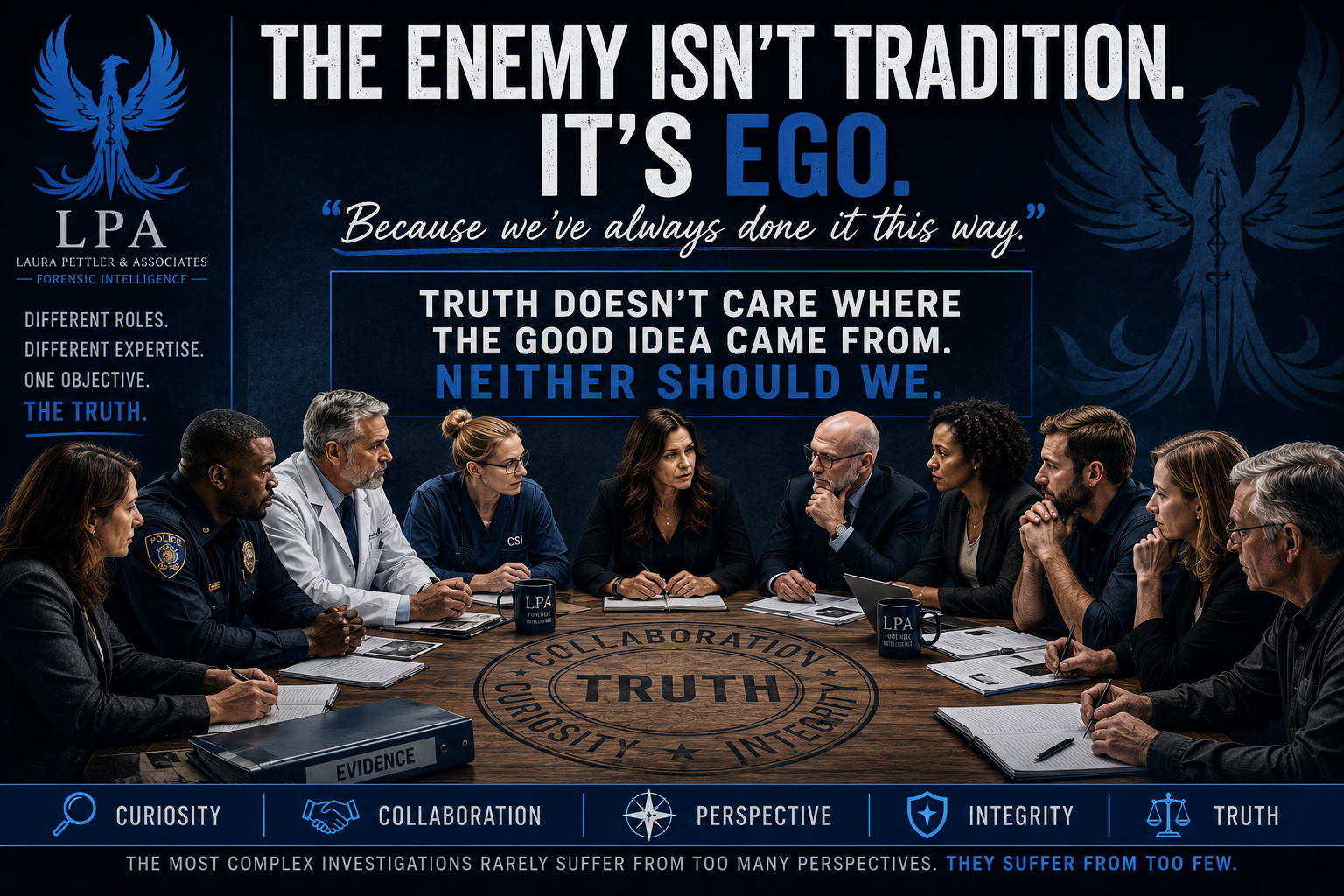
I've never cared whether someone wears a badge, carries a firearm, has a Ph.D., is male or female, works for a sheriff's office, serves in a private laboratory, volunteers in the community, or works in the private sector. I care whether a person can contribute something that moves the investigation closer to the truth. I care about character, integrity, best practices, and verifiable facts.
Some of the most productive investigative roundtables I've participated in have included coroners, detectives, crime scene analysts, medical examiners, forensic pathologists, forensic anthropologists, behavioral scientists, digital forensic examiners, engineers, search and rescue professionals, dispatchers, private investigators, prosecutors, attorneys, researchers, academics, veterinarians, equine behavior specialists, and information technology experts.
At first glance, that might seem like an unusual combination of professions. It isn't. Every one of those disciplines examines the same case through a different lens. The homicide detective may recognize investigative patterns. The forensic pathologist understands injury and disease. The behavioral scientist studies human decision-making. The digital forensic examiner reconstructs electronic activity. The engineer explains structural failure or vehicle dynamics. The veterinarian may identify animal evidence or interpret injuries involving animals. The search and rescue specialist understands terrain, human movement, and environmental influences. The dispatcher may hear something on the original 911 recording that others overlook. The attorney evaluates how evidence will ultimately withstand legal scrutiny.
None of these perspectives compete with one another, they complement one another. The most complex investigations rarely suffer from too many perspectives, they suffer from too few. Intellectual humility is what I say…have a little.
Somewhere along the way, American law enforcement became concerned with titles, credentials, jurisdictions, and organizational boundaries. Some experts are consumed with self-promotion, fame, being right, fans, and being first. They are completely missing the point of why we should be in this field. As the head of LPA with the most elite roundtable of experts in the world, I started by asking, "Who should be allowed at the table?" when the better question has always been, "Who can help solve this case?" This is always what I ask now.
Bottom line: Truth doesn't care where the good idea came from. Neither should we. And quite frankly, neither does a grieving family left in agony because someone stopped doing their job when they walked into a death scene.
“Because we’ve always done it this way” doesn’t fly at LPA and shouldn’t fly in American homicide investigations either.