

When the Answers Matter: Introducing Equine Injury & Fatality Investigations
Throughout my career, I have spent thousands of hours investigating deaths, reconstructing events, analyzing evidence, and asking difficult questions when the facts did not seem to align with the explanation being offered. Most of that work has involved human fatalities, suspicious deaths, cold cases, and complex forensic investigations. Yet as both a forensic criminologist and lifelong equestrian, I have often found myself wondering why the same level of independent investigation is rarely available when the victim is a horse.
When a horse dies unexpectedly, owners are frequently left with more questions than answers. A horse may collapse during transport. A riding accident may result in catastrophic injuries. A horse may die while boarded at a facility, under veterinary care, during training, or under circumstances that simply do not make sense to the people who knew the animal best. In many cases, emotions run high, information is limited, and conflicting accounts begin to emerge. Families, owners, trainers, barns, insurance carriers, and attorneys are often forced to make important decisions without a clear understanding of what actually occurred.
The reality is that horses cannot tell us what happened.
They cannot describe the sequence of events leading up to an injury. They cannot explain how a gate was left open, whether a trailer was operated safely, whether proper supervision was provided, or whether warning signs were overlooked. The only voice available to them is the evidence itself.
That evidence may exist in photographs, videos, veterinary records, witness statements, transportation records, facility conditions, timelines, necropsy findings, digital communications, or physical evidence. Like any other investigation, the truth is often found by assembling those pieces into a coherent and evidence-based reconstruction of events.
This need for answers extends beyond equine fatalities alone. Every year, riders, trainers, handlers, farm workers, and equestrian professionals are seriously injured or killed in horse-related incidents. While many of these events are tragic accidents, some raise legitimate questions regarding supervision, facility conditions, equipment failures, training practices, transportation procedures, or other contributing factors. Determining what happened—and whether it could have been prevented often requires a careful and objective review of the available evidence.
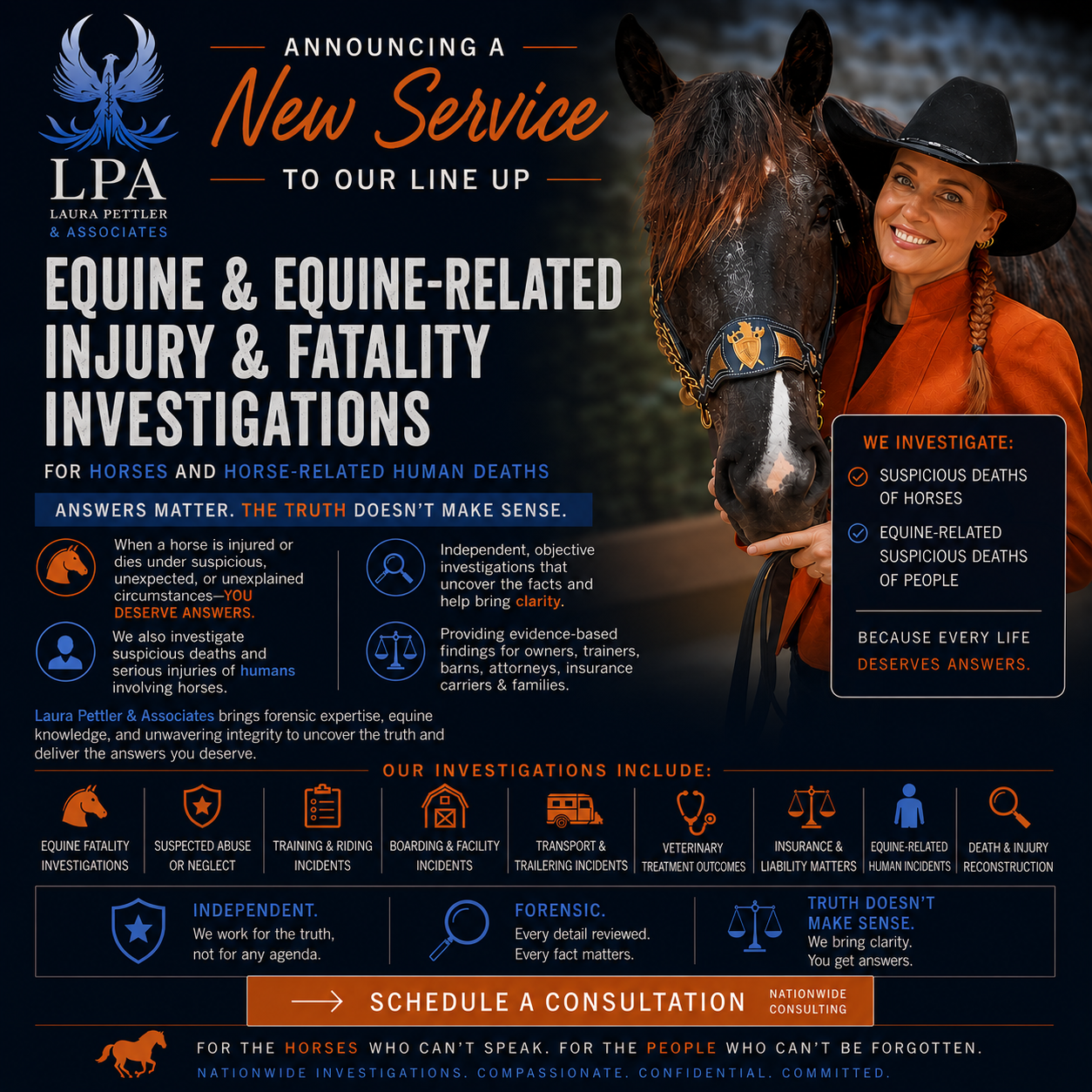
This is why Laura Pettler & Associates is expanding our services to include Equine Injury & Fatality Investigations.
These investigations may involve suspicious or unexplained equine deaths, suspected abuse or neglect, boarding and facility incidents, training and riding accidents, transportation and trailering events, veterinary treatment outcomes, insurance and liability matters, equine death reconstruction, and horse-related human injuries or fatalities.
Our approach is rooted in the same principles that guide every forensic investigation we conduct: objectivity, evidence, and independent analysis. We do not begin with assumptions. We follow the facts wherever they lead. Sometimes those facts confirm what people believe happened. Other times they reveal a very different story.
The equestrian world is built on trust. Owners trust trainers. Trainers trust facilities. Riders trust equipment, veterinarians, transportation providers, and the people responsible for the care of their horses. When something goes wrong, that trust can be shattered in an instant. The resulting questions often linger long after the event itself.
Not because they can undo a tragedy, but because they can provide clarity, accountability, and understanding. They can help families make informed decisions. They can assist attorneys and insurance carriers in evaluating claims. They can identify risks that may prevent future injuries. Most importantly, they can give a voice to those who can no longer speak for themselves.
At Laura Pettler & Associates, we believe every horse deserves answers. We believe every family deserves the truth. And when the facts matter, we believe the evidence should be allowed to speak. Whether the victim walks on two legs or four, our pursuit of the truth remains the same.